Beijing Suspends Sanctions on US Shipbuilder After Tariff Pause

Beijing Suspends Sanctions on US Shipbuilder After Tariff Pause

.

Beijing announced on Nov. 10 the suspension of sanctions on a leading U.S. shipbuilder, citing an agreed-upon pause to related tariffs by the United States.

The Chinese Ministry of Commerce had imposed the sanctions on five U.S. subsidiaries of South Korean conglomerate Hanwha in response to Section 301 penalties imposed on China by the United States.

The ministry had cited an “anti-foreign sanctions” law that allows Beijing to impose retaliatory measures when sanctioned.

Hanwha acquired the Philly Shipyard in 2024 and is poised to ramp up U.S. shipbuilding, a priority of the Trump administration.

The announcement comes a day after the office of the U.S. Trade Representative (USTR) announced a suspension of penalties—fees and up to 150 percent tariffs—that had been imposed after a Section 301 investigation into China’s actions in the maritime, logistics, and shipbuilding sectors.
.
In April, President Donald Trump issued an executive order that highlighted the nation’s reliance on foreign shipbuilding as a strategic vulnerability, stating the United States builds one percent of ships globally while China produces close to half.
.
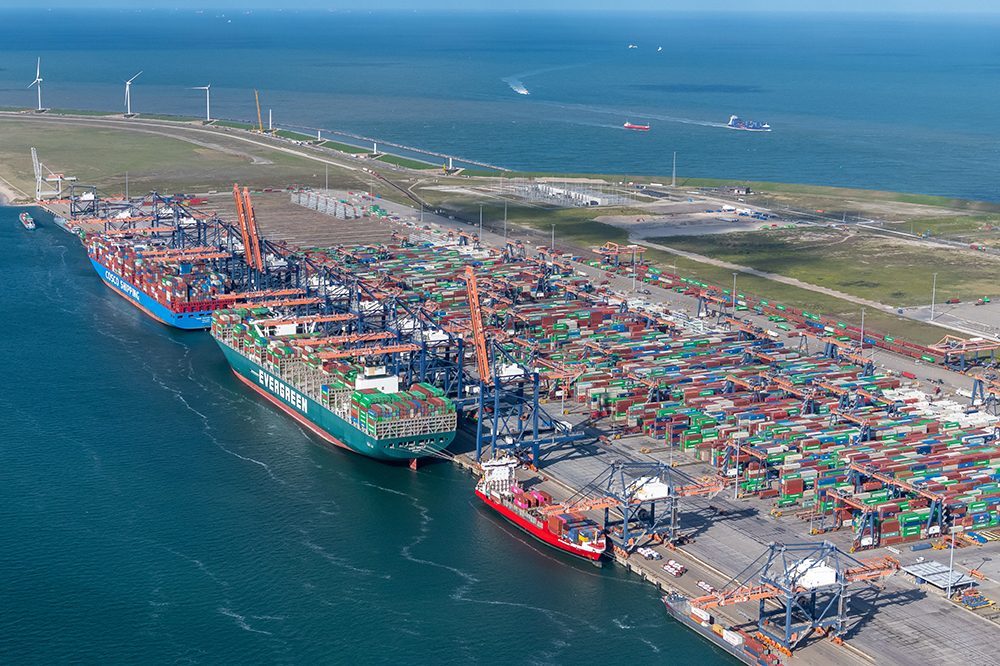
Under Section 301 of the Trade Act, the USTR can investigate whether foreign trade partners have engaged in unfair trade practices. In April, after determining that China had burdened or restricted U.S. commerce by targeting “the maritime, logistics, and shipbuilding sectors for dominance,” the USTR proposed transport service fees on Chinese operators and shipowners, fees on operators using Chinese-built ships, fees on transport services of foreign-built vehicle carriers, and tariffs on ship-to-shore cranes and other cargo-handling equipment from China.

Chinese-made ship-to-shore cranes account for 80 percent of those used in U.S. ports, and have been flagged as a strategic vulnerability in multiple ways, including for potential malicious cyberactivity that could disrupt trade or military activity.

As a result of the investigation, the USTR announced last month 100 percent tariffs on ship-to-shore cranes and up to 150 percent tariffs on other cargo-handling equipment from China. The tariffs had been set to go into effect on Nov. 9.
Michael Roberts, senior fellow at the Hudson Institute and cofounder of the American Maritime Security Initiative, wrote recently for Hanwha that Chinese manufacturers make three vessels for the Chinese navy for every one that American shipbuilders deliver to the U.S. Navy. He noted that China’s shipbuilding dominance accelerated drastically in recent years.

“Last year, China secured about 75 [percent] of global new ship orders, while South Korea and Japan together claimed only 20 [percent]. Just five years ago, Korea and China were neck and neck at about 37 [percent] each,” Roberts wrote.

The suspension of the penalties follows an agreement reached by Trump and Chinese Communist Party leader Xi after a bilateral meeting on Oct. 30.

The USTR opened public comments into the likely suspension on Nov. 6, and received about 70 comments over the next few days, mostly in favor of a suspension over concerns about trade disruption.

The USTR has stated that negotiations will continue with Beijing over the results of the Section 301 investigation.

.