

As CCP Cybersabotage Escalates, US Changes Posture

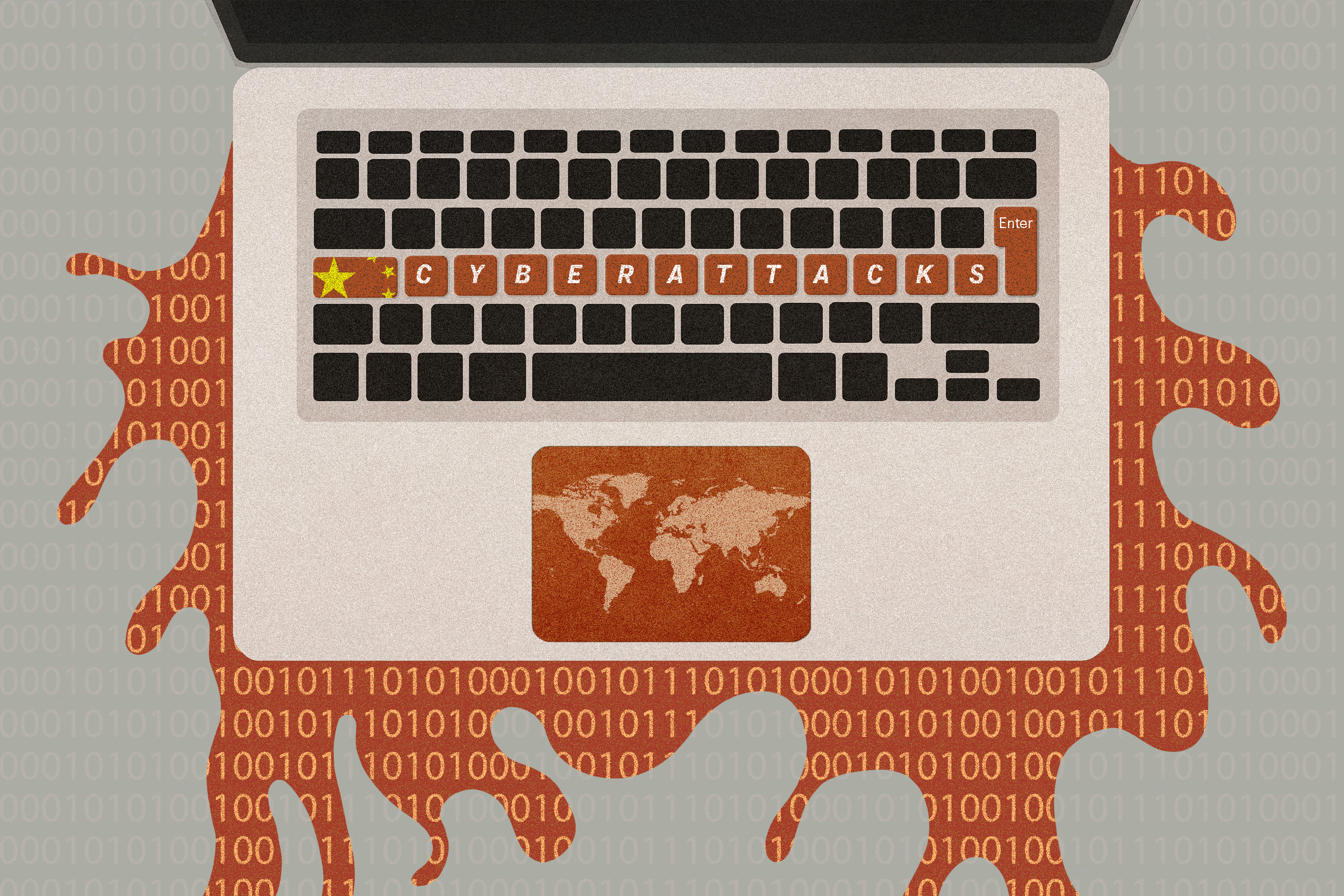
Once considered mainly an economic thief in cyberspace, the Chinese Communist Party (CCP) is now seen by the U.S. military as its top cyberthreat and “pacing adversary,” capable of not only espionage, but also potential sabotage of lifeline systems.
The recent large-scale hacks into U.S. critical infrastructure and telecommunications networks that went undetected for months, if not years, seemed a far cry from the unsubtle, brute-force cyberactivity of earlier years and brought new attention to the issue.
The shift on the regime’s part was not sudden, but rather the natural outgrowth of some 30 years of heavy investment in the cybersector.
CCP Builds Up Cybersector
In 1996, Kevin Mandia was a special agent at the Air Force Office of Special Investigations when he saw his first Chinese state-sponsored cybercampaign infiltrate “27 or 37 military bases” unencumbered.Mandia saw the Marine Corps, Army, Air Force, and Department of Energy breached on day one of the CCP-backed campaign as remote actors gained access via a West Coast university, with legitimate credentials belonging to several former Chinese international students whose accounts were never closed.
It showed the systemic nature of a state-backed campaign, according to Mandia, as division of labor was evident in the hack: One person or team was tasked with the testing of credentials, and another with the exfiltration of data.
The CCP People’s Liberation Army has had cyberunits since the 1990s, whereas it was not until 2009 that the United States established U.S. Cyber Command, or Cybercom, to unify cyberoperations.

“We did it to genuinely push the agenda of ‘China’s literally hacking everybody and nobody knows it,'” Mandia, former CEO of Mandiant, said at the RSA Conference.
CCP leader Xi Jinping, whose tenure has been characterized by openly aggressive competition against the United States, stated his intention to have the regime become a superpower in cyberspace a few years after he came to power in 2015. Official speeches and documents outlined the need to secure cyberpower as a pillar of economic, national, and military security.
The same year, Xi stated the regime’s renewed focus on the CCP’s strategy of “military-civil fusion,” which blurs the lines between technologies for commercial use and for military use, emphasizing the lack of a true private sector in communist China.
In the decade since, the CCP’s investment in cybercapabilities has been unmatched.
One example is the hacking competition landscape in China, which provides hands-on experience, knowledge sharing, and career paths for an ever-growing industry of hackers.
“The best 10,000 [cyberoperatives] in the United States are better than the best 10,000 in China,” Rosenzweig told The Epoch Times. “But if the United States has 100,000 [cyberoperatives], China has 1 million.”
Cybersecurity researchers say Chinese state-backed cyberactivity has been more difficult to detect as of late, which indicates not only a fine-tuning of techniques, but also an increased emphasis on operational security and infrastructure management in these organized campaigns.
.

US Changes Posture
David Stehlin, CEO of Telecommunications Industry Association (TIA), was running a venture-backed company in 2002 when he had his first encounter with Huawei. The Chinese telecom giant had stolen some of his company’s technology.Years later, when Stehlin was CEO of a publicly traded company, Huawei would outbid his company for contracts around the world by 40 percent or 50 percent, selling below cost and making it impossible to compete.
Lawmakers, officials, and experts around the world had raised national security concerns about Chinese telecom services, including Huawei, by the early 2000s. But it was during the first Trump administration, which named Huawei/ZTE telecom equipment as a threat to national security, that Stehlin said he saw a real shift begin.
At the time, one-third of the world was using Huawei/ZTE technology, one-third of the world was using trusted technologies, and another third had not yet made up its mind, Stehlin told The Epoch Times. The Trump administration not only made the choice for trusted technologies at home, but also engaged countries around the world to “number one, tell them about the risks, and number two, show them a path to a more secure network,” Stehlin said.
“The [first Trump administration] recognized that we need more trusted technology in the communications infrastructure around the world,” Stehlin said. In today’s connected world, where nearly all internet traffic travels through subsea cables, breaches in other countries can result in vulnerabilities to systems at home, as well.
Defense experts and critical infrastructure industry veterans broadly credit President Donald Trump in his first administration for the nation’s recognition of the CCP as a cyberadversary. This finally opened a path for a coordinated solution.
Telecommunications networks are especially high-value targets, being subject to both cyberespionage and potential cyberattacks, and there had already been well-documented cases of Chinese state-owned telecom companies rerouting U.S. or European data to China. As the United States committed millions in taxpayer dollars to spend the next decade ripping out these untrusted technologies, the industry also began to overhaul its approach to security.
.

“Organizations have started to shift from being reactive to being proactive,” Stehlin said. “Security needs to be embedded into this digital transformation that’s been going on for some time, and will continue for some time, starting with a deep understanding of how companies make products, and the subsystems that they use, and the chips that they use.”
Terms such as “zero trust architecture,” “defense in depth,” and “secure by design” reflect this shift in approach. Best practices dictate that a company build security into the product or service development process from the beginning and prepare for the event of a breach. The approach incorporates multiple layers of security to contain any potential breach and employs continuous monitoring and threat hunting within the system.
“Can you trace the software all the way back to its source?” Stehlin said. “How quickly do you fix a problem when you have a problem? How do you know that the chips you’re using are not counterfeit chips? Are you, as a company, a trusted supplier?
“We’re not just throwing it up in the air and saying, ‘Trusted or not trusted?’ No, these are measurable elements that we use to evaluate trust.”
Series of ‘Typhoons’
Ten years after the Mandiant report sparked recognition that China-based hacking campaigns against the United States were in fact state-sponsored, Microsoft disclosed a “stealthy and targeted malicious” CCP-backed cybercampaign aimed at U.S. critical infrastructure, which it dubbed “Volt Typhoon.”In a May 2023 report, Microsoft detailed how Volt Typhoon had been active since mid-2021 and affected organizations in the communications, manufacturing, utility, transportation, construction, maritime, government, IT, and educational sectors. It highlighted the campaign’s emphasis on stealth, with techniques that mimic legitimate activity so as to avoid detection for as long as possible.
Microsoft assessed with moderate confidence that Volt Typhoon was also pursuing capabilities to disrupt the critical infrastructure in the event of conflict. The need for increased protection that came with heightened awareness had prompted the disclosure. A year later, FBI head Christopher Wray told lawmakers that Volt Typhoon was pre-positioned for disruption.

Volt Typhoon’s stealthy approach and its potential goal of disrupting critical infrastructure were markedly different from what CCP-backed hackers had previously demonstrated, and it was only one of several new campaigns.
The “Typhoon” designations are what Microsoft uses to track CCP-backed campaigns, but different security researchers use other names.
“Salt Typhoon, Volt Typhoon—there’s just a legion of possible avenues here,” Rosenzweig said about the campaigns’ potential for disruption. It is “reasonably apparent” that the Chinese regime may be looking for something to hold as surety against potential U.S. action, he said.
Jeff Hoffmann, senior cyber fellow at The Gold Institute for International Strategy, told The Epoch Times that with these various new campaigns, the CCP is “really on the move in terms of exploring where there may be vulnerabilities and to show that [it has] a presence.”
Imposing ‘Costs’
Stakeholders began to ask whether the United States would hit back.At the same hearing, Sen. Elissa Slotkin (D-Mich.) said, “I want to do offensive cyber, I want to make them feel pain, for the Russians and the Chinese that are launching these attacks.”
“If China does go beyond pre-positioning and [does] what Iran has done in Israel to actually have an impact on industrial control systems—say, in a water treatment plant—if that does come to a disruptive level, what is our response?” he said. “We need to develop that policy.
.

“We need to thank President Donald J. Trump on his leadership—immediately when he was inaugurated, he renewed the national emergency to mitigate, deter, and defeat foreign adversaries in cyber, and that includes China.”
Hoffmann said he sees a likely Trump–Xi meeting as a prime opportunity for this administration to make its position clear.
The Trump administration’s new cyberofficials have also committed to showing adversaries that cyberactivity against the United States is unacceptable.
“Not responding is, I think, escalatory in its own right,” Bulazel said. “If you continually let the adversary walk all over you—they hack you and you do nothing, and they hack you—that in itself sets a norm.
“We need to find some way to communicate that this is not acceptable.”
Longtime FBI agent Brett Leatherman, promoted in June to lead the agency’s cybercrime division, stated in the announcement that his charge was to make malicious cyberactivity against the United States “unsustainable.”
“Our enemies do not see a cost in engaging in this behavior, so they impose strategic dilemmas on us now, and they have for a long period of time,” he said.
“It’s time that we impose those dilemmas on them. I look forward to working, to do everything that I can, to make sure that our adversaries, our enemies, and criminals operating in this space know that this is not a cost-free endeavor.”
.
What's Your Reaction?
 Like
0
Like
0
 Dislike
0
Dislike
0
 Love
0
Love
0
 Funny
0
Funny
0
 Wow
0
Wow
0
 Sad
0
Sad
0
 Angry
0
Angry
0














Comments (0)