

Vietnam Draws a Line as China Builds Again in the Disputed Paracels
Vietnam has formally protested new Chinese construction on a South China Sea islet, demanding Beijing halt all activity in the disputed Paracel Islands. The move follows satellite evidence of what analysts believe is an early-warning radar site, part of a broader pattern of Chinese militarization that has alarmed regional neighbors and Washington alike.

.
Vietnam Draws a Line as China Builds Again in the Disputed Paracels
Vietnam has issued a sharp diplomatic protest against China, demanding an immediate halt to construction activity on a small islet in the Paracel Islands. The demand, delivered by Hanoi's Foreign Ministry on Friday, comes just days after satellite images revealed new structures rising on the remote outpost.
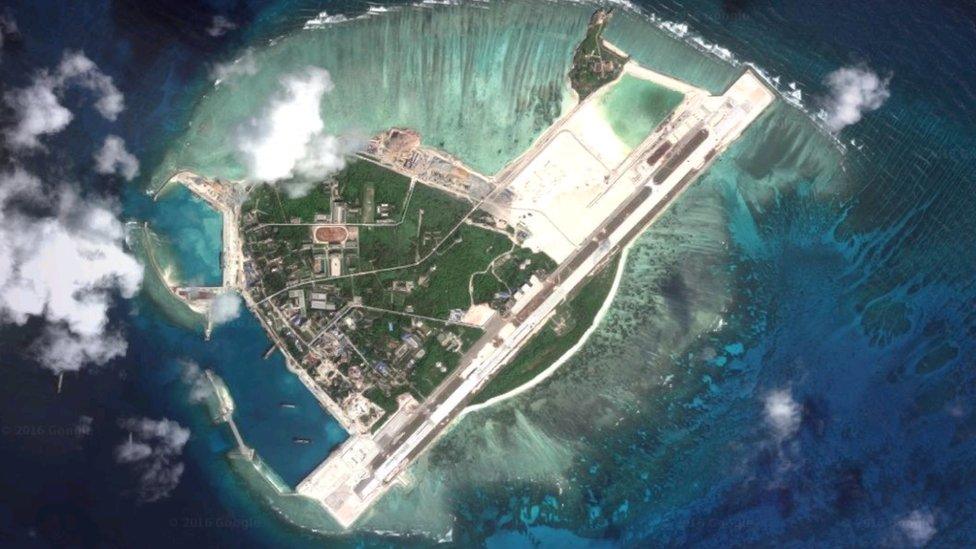
The dispute centers on Yagong Island, known to Vietnam as Ba Ba Island, a tiny feature in the Paracels chain that Beijing has controlled since seizing it from South Vietnamese forces in 1974. Security analysts who reviewed the imagery say the new buildings resemble an early-warning radar installation, a facility that would extend China's surveillance reach deep into contested waters.
.
Hanoi Rejects Beijing's Claims Outright
Foreign Ministry spokesperson Pham Thu Hang left little room for ambiguity in her statement. Vietnam, she said, "resolutely opposes" the construction, has lodged formal representations, and insists the work stop immediately and never resume.
Hang went further, declaring that any foreign activity in the Paracels conducted without Hanoi's consent is "completely illegal and null and void." That statement covers not only Ba Ba Island but also Hai Sam Reef (known internationally as Antelope Reef), another site where China has been steadily expanding its footprint.
Vietnam bases its claim on what it describes as extensive historical and legal evidence, arguing its sovereignty over the entire archipelago is grounded in international law. China's Defence Ministry has so far declined to respond to requests for comment.
.
A Decades-Old Dispute, Freshly Inflamed
The roots of this standoff run back more than fifty years. China took the Paracels from the navy of the former South Vietnam in a brief but bloody 1974 naval battle, and has controlled the island chain ever since, despite Vietnam's unbroken sovereignty claim over the entire grouping.
The Paracels sit at the northern edge of a much larger and more crowded dispute. Further south, the Spratly Islands and their surrounding waters are claimed in whole or in part by Vietnam, the Philippines, Malaysia, Taiwan, and Brunei, making the South China Sea one of the world's most contested maritime regions. Vietnam itself has expanded its own base network in the Spratlys in recent years, underscoring how every claimant in the region is racing to solidify its position.
.
Part of a Larger Pattern of Chinese Expansion
The Ba Ba Island construction is not an isolated incident. According to independent analysis from the Center for Strategic and International Studies' Asia Maritime Transparency Initiative, China has for months been carrying out large-scale land reclamation at nearby Antelope Reef, work that could turn it into the largest artificial feature Beijing controls in the South China Sea.
Commercial satellite imagery reviewed by independent monitors shows the reclamation project has already produced an artificial island stretching nearly six kilometers, built up over at least six months of dredging and landfill work. Reporting from Radio Free Asia notes that China's Foreign Ministry has defended the activity as "necessary construction on our own territory," insisting the islands are Beijing's "inherent territory" and rejecting any dispute over the matter.
Maritime security researchers tracking vessel movements around the Paracels have also documented a build-up of Chinese coast guard, maritime militia, and law-enforcement ships forming what one open-source intelligence group described as a tightening security cordon around the archipelago, increasingly squeezing out Vietnamese fishing and patrol boats from waters they have long used.
.
Why This Matters Beyond Hanoi and Beijing
For Washington and its allies, incidents like this one are read as part of a consistent playbook: quiet, incremental construction on remote reefs that gradually hardens into permanent military infrastructure. Analysts warn that a radar facility at Ba Ba Island would likely support operations at the much larger Antelope Reef buildup nearby, extending China's ability to monitor and potentially contest movement through one of the world's busiest shipping corridors.
The Chinese Communist Party has repeatedly used exactly this kind of gradual, deniable expansion to shift facts on the ground in the South China Sea without triggering direct military confrontation. Critics argue this strategy allows Beijing to test the resolve of smaller neighbors like Vietnam, whose formal protests carry little enforcement power on their own.
.
What Comes Next
Vietnam's protest is unlikely to halt construction on its own; Hanoi has issued similar demands before, including over previous work at Antelope Reef, without any visible change in Chinese behavior. The more important question is whether the United States and regional partners such as the Philippines respond with concrete steps, such as increased naval patrols or diplomatic pressure, to back Vietnam's position.
For now, the episode adds one more data point to a pattern that shows no sign of slowing: China continuing to build, and its neighbors continuing to object, in one of the most strategically vital and contested waterways on Earth.
.
Sources
- Reuters — "Vietnam demands end to activity in Paracels after report of Chinese construction" — https://www.reuters.com/world/china/vietnam-demands-end-activity-paracels-after-report-chinese-construction-2026-08-28/
- Radio Free Asia — "Vietnam protests China's development of disputed reef in South China Sea" — https://www.rfa.org/english/southchinasea/2026/03/23/vietnam-china-paracels-antelope-reef/
- Reuters — "New installations emerge on islet as China accelerates South China Sea build-up" — https://www.reuters.com/world/china/new-installations-emerge-islet-china-accelerates-south-china-sea-build-up-2026-08-25/
- SeaLight / Open Source Centre — "China's Paramilitary Wall Rises Against Vietnam Around the Paracel Islands" — https://www.sealight.live/posts/china-s-paramilitary-wall-rises-against-vietnam-around-the-paracel-islands
.
What's Your Reaction?
 Like
0
Like
0
 Dislike
0
Dislike
0
 Love
0
Love
0
 Funny
0
Funny
0
 Wow
0
Wow
0
 Sad
0
Sad
0
 Angry
0
Angry
0













Comments (0)