

Taiwan's "Cat Warrior": The Woman Beijing Fears Most
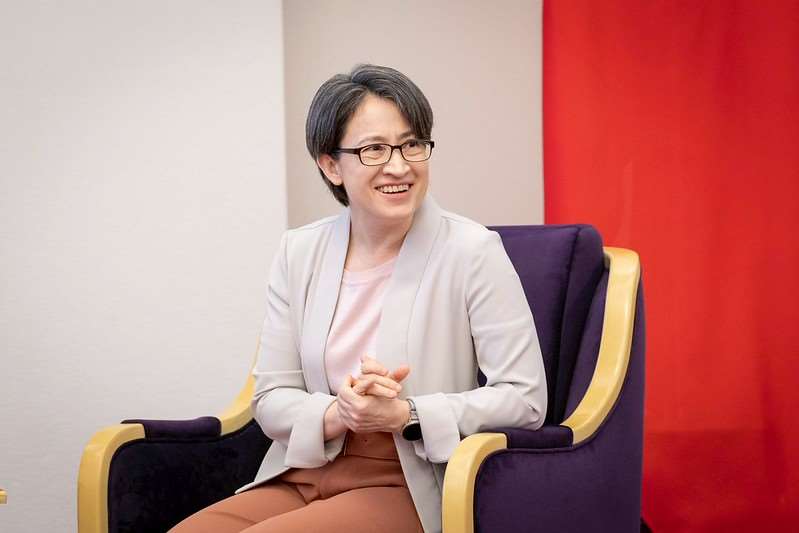
Hsiao Bi-khim, Taiwan's Vice President, has become one of Asia's most effective and fearless diplomats. As China escalates pressure on the island daily, she is expanding Taiwan's global reach in ways Beijing cannot easily block — through chips, alliances, and a steel-nerved brand of diplomacy she calls "cat warrior."

.
The Woman on Beijing's Blacklist
She was born in Kobe, Japan, to a Taiwanese father and an American mother. She grew up translating between grandmothers who spoke different languages. Today, Hsiao Bi-khim is translating something far larger — Taiwan's will to survive — for the world.
Now serving as Taiwan's 16th Vice President under President Lai Ching-te, Hsiao has spent decades navigating some of the most dangerous terrain in global politics. The Chinese Communist Party (CCP) has placed her on its blacklist twice, labeling her a "diehard separatist" and accusing her of colluding with the United States. Beijing has even threatened the death penalty for what it calls "Taiwan independence" activity.
Hsiao's response? She is not impressed.
"We will not let the Communist Party of China define who we are," she has said. Since she has no personal business ties to China, Beijing's sanctions against her carry little practical weight. They are, as she sees it, little more than noise.
A "Cat Warrior" Among Wolf Warriors
When Hsiao arrived in Washington in 2020 as Taiwan's representative to the United States, she needed a way to position herself against China's aggressive "wolf warrior" diplomats — officials known for their confrontational and often threatening rhetoric on the international stage.
She chose a different animal.
Her "cat warrior" approach emphasizes flexibility, nimbleness, and quiet resilience — qualities she has demonstrated consistently. Taiwan, she argues, can be warm and approachable while keeping its claws sharp. "Cats cannot be coerced," she has explained. "They have a mind of their own."
That philosophy has yielded real results. In November 2025, she traveled to Brussels and delivered a rare address at the European Parliament — the first time a Taiwanese vice president had spoken in the parliament of a country without formal diplomatic ties to Taipei. Despite furious protests from Beijing, which accused the European Parliament of violating the "one China" principle, the event went ahead. Taiwan's Foreign Minister called it a historic milestone and "the opening of a new chapter" in Taiwan-EU relations.
A Life Between Worlds
Hsiao's biography reads like a handbook for cross-cultural bridge-building. After growing up in Tainan, Taiwan, she moved to the United States and earned a bachelor's degree in East Asian Studies from Oberlin College in 1993. She later completed a master's in political science at Columbia University.
She entered politics early. By 2001, she was a member of Taiwan's Legislative Yuan, the island's parliament. During her legislative career, she championed gender equality, human rights, and diplomatic outreach — earning a reputation as one of Taiwan's most internationally connected politicians.
Her appointment as Taiwan's representative to the United States in July 2020 put her at the center of the most consequential bilateral relationship in the Indo-Pacific. During her tenure in Washington, she worked to build bipartisan consensus in the U.S. Congress on Taiwan issues — a skill she describes as finding common ground across political lines to make the two countries "force multipliers" for each other.
The Threats Are Real — and Growing
Taiwan's Vice President does not downplay the danger her country faces. In a July 2025 briefing for foreign media, Hsiao described what she called a "dramatic uptick" in CCP efforts to infiltrate, sabotage, and divide Taiwanese society. "We do not seek conflict. We will not provoke confrontation," she said, while making clear that Taiwan will not simply absorb Beijing's pressure indefinitely.
The military dimension is stark. According to Taiwan's National Security Bureau, 2025 set a record with 3,570 Chinese military aircraft incursions into Taiwan's surrounding airspace. China's People's Liberation Army has been conducting near-daily intimidation exercises, along with large-scale drills that simulate a blockade or invasion.
The threats are not only military. During a 2024 visit to Prague, Chinese diplomats and agents reportedly followed Hsiao's delegation and allegedly plotted to stage a car crash — weeks before she was due to take office as Vice President. In January of the following year, Czech authorities arrested a Chinese state media correspondent who had allegedly attempted to gather compromising material on pro-Taiwan politicians.
Hsiao frames all of this as intimidation that Taiwan is learning to counter with equal creativity.
The Silicon Shield and the $250 Billion Deal
Taiwan's most powerful deterrent may not be military at all. The island of just over 23 million people produces approximately 60 percent of the world's semiconductors — and nearly all of the most advanced ones. That makes Taiwan indispensable to the global digital economy in a way no amount of CCP pressure can easily erase.
Last year, Taiwan surpassed Germany to become America's fourth-largest trading partner. In January 2026, that economic partnership deepened dramatically. Under a landmark bilateral trade agreement, Taiwanese semiconductor and technology companies committed to at least $250 billion in direct investment in U.S.-based chip manufacturing, artificial intelligence, and energy infrastructure. The U.S. government in turn lowered tariffs on Taiwanese goods and committed to supporting Taiwan's own technology sector.
The deal, welcomed by U.S. Commerce Secretary Howard Lutnick as a decisive step toward rebuilding American chipmaking capacity, underscored what Hsiao has long argued: the U.S.-Taiwan relationship is not charity. It is mutual.
Taiwan's GDP per capita in 2026 stands at roughly triple that of mainland China, according to International Monetary Fund data — a testament, Hsiao argues, to what democratic governance and free markets can achieve compared to CCP-style state control.
Arming Up — Against Political Resistance at Home
President Lai Ching-te has set an ambitious target: raise Taiwan's defense spending from roughly 3.3 percent of GDP today to 5 percent by 2030 — in line with NATO benchmarks. To accelerate that process, he proposed a landmark $40 billion supplementary defense budget covering eight years, focused on advanced missile defense systems, long-range precision weapons, and unmanned platforms.
The plan hit serious political turbulence at home. Taiwan's legislature is controlled by the opposition Kuomintang (KMT) and Taiwan People's Party (TPP), both of which favor closer engagement with Beijing. The opposition blocked the special defense budget repeatedly before a slimmed-down version finally advanced. Critics in Washington grew frustrated; some U.S. officials warned that delays could signal weakness to Beijing and misplaced priorities to allies.
Hsiao frames the political struggle differently — as proof that Taiwan's democracy works, even under pressure. Legislative debate, however frustrating, is transparency in action. Her government, she says, will continue making the case to the Taiwanese public that investing in defense is not an option — it is survival.
In early June 2026, Taiwan test-fired its U.S.-supplied rocket artillery system in the direction of the Chinese mainland, simulating defense against an invasion. The message was deliberate.
Small Island, Long Reach
Taiwan has embedded itself in what Hsiao describes as "every layer" of the global artificial intelligence and technology supply chain. Beyond chips, the island is positioning itself as a reliable partner in healthcare, clean energy, and democratic governance for an increasingly fragile international order.
Hsiao's vision of "cat diplomacy" is ultimately about leverage through reliability. A small island cannot match China's raw power. But it can make itself irreplaceable — economically, technologically, and as a model of what a free society can build.
"Cats — they're small," she has said, "but they can jump ten times their height or more."
"And they've got nine lives."
.
Sources:
- Office of the President, Republic of China (Taiwan) — Hsiao Bi-khim official biography: https://english.president.gov.tw/Page/645
- PBS NewsHour — Taiwan will 'not provoke confrontation' with China, VP Hsiao says (July 2025): https://www.pbs.org/newshour/world/taiwan-will-not-provoke-confrontation-with-china-vice-president-hsiao-says
- Focus Taiwan (CNA) — Taiwan doing all it can to prevent war, VP Hsiao says (October 2025): https://focustaiwan.tw/politics/202510280017
- Focus Taiwan (CNA) — Hsiao's Brussels speech a first for Taiwan VP in non-diplomatic ally (November 2025): https://focustaiwan.tw/politics/202511090006
- CNBC — Taiwan will invest $250 billion in U.S. chipmaking under new trade deal (January 2026): https://www.cnbc.com/2026/01/15/us-taiwan-chips-deal-china.html
- Council on Foreign Relations — New U.S.-Taiwan Trade and Chip Deal Announced (January 2026): https://www.cfr.org/articles/new-us-taiwan-trade-and-chip-deal-announced
- NPR — The Taiwanese president's proposal to hike defense spending faces gridlock at home (January 2026): https://www.npr.org/2026/01/22/nx-s1-5683130/taiwan-defense-spending
- Bloomberg — Taiwan's Lai Says Defense Spending to Reach 5% of GDP by 2030 (August 2025): https://www.bloomberg.com/news/articles/2025-08-22/taiwan-s-lai-says-defense-spending-to-reach-5-of-gdp-by-2030
- Al Jazeera — Taiwan unveils $40bn budget for defence spending to counter China (November 2025): https://www.aljazeera.com/news/2025/11/26/1768
- Brookings Institution — Defense in a democracy: Political competition and Taiwan's special defense budget (March 2026): https://www.brookings.edu/articles/defense-in-a-democracy-political-competition-and-taiwans-special-defense-budget/
.
What's Your Reaction?
 Like
0
Like
0
 Dislike
0
Dislike
0
 Love
0
Love
0
 Funny
0
Funny
0
 Wow
0
Wow
0
 Sad
0
Sad
0
 Angry
0
Angry
0









Comments (0)