

Taiwan Wants a "Hornet's Nest" of Drones to Keep China at Bay
A senior U.S. diplomat says swarms of Taiwanese drones could be the island's best deterrent against Beijing. But Taiwan's own parliament is still fighting over how to pay for them.

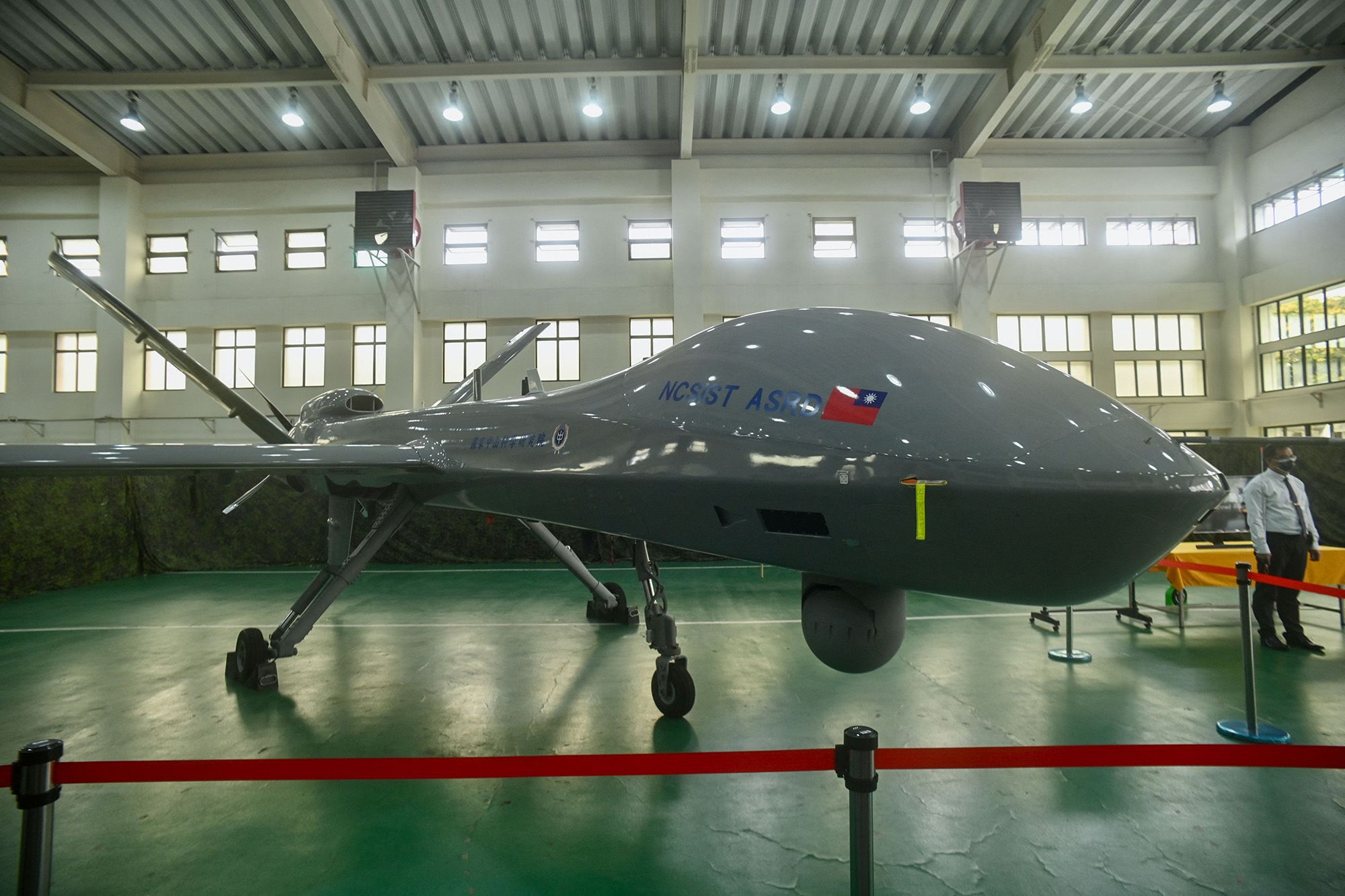
.
Taiwan's government and its most important ally, the United States, agree on one thing: the island needs far more drones, and fast. What they don't agree on with Taiwan's own opposition parties is how to fund them.
.
A Blunt Warning From Washington's Man in Taipei
Speaking at a drone industry forum in the central city of Taichung on Thursday, Raymond Greene, the top U.S. representative in Taiwan, said the island should turn itself into a "hornet's nest" of air, sea and underwater drones. He called unmanned systems a "game-changing opportunity" to strengthen Taiwan's defenses and help keep peace in the wider region.
Greene runs the American Institute in Taiwan (AIT), the unofficial embassy that handles U.S.-Taiwan relations in the absence of formal diplomatic ties. Washington remains Taiwan's largest arms supplier and most vocal international backer, even without an official embassy on the island.
Greene pointed to Ukraine as proof of concept. Despite facing a much larger invading force, Ukrainian troops have used cheap, mass-produced drones to blunt Russian attacks. "Nothing will deter conflict more effectively," Greene said, "than turning Taiwan into a hornet's nest of air, surface, and subsurface drones."
.
Why Taiwan Feels the Pressure
China's ruling Communist Party claims Taiwan as its own territory, even though it has never controlled the self-governing democracy. Beijing has repeatedly refused to rule out using force to bring the island under its control, and has stepped up military pressure in recent years, including large-scale drills around Taiwan.
Taiwanese President Lai Ching-te, who rejects Beijing's sovereignty claims, has made drones a centerpiece of the island's defense strategy. "Building asymmetric combat capabilities is a national defense project that is a race against time," Lai told his Democratic Progressive Party (DPP) on Wednesday.
Drones and other low-cost "asymmetric" weapons are seen as a way for Taiwan to raise the cost of any Chinese attack without matching China's military spending ship-for-ship. The Trump administration has continued the long-standing U.S. policy of backing Taiwan's defense buildup, part of a broader push to strengthen deterrence across the Indo-Pacific.
.
A Budget Fight in Taipei
Turning that strategy into hardware requires money, and that is where Taiwanese politics gets messy. In May, the opposition-controlled parliament approved only about two-thirds of the $40 billion in extra defense spending Lai had requested, and set aside funds only for U.S. arms purchases, cutting domestic drone programs.
The government has since proposed a new special budget of NT$210 billion (roughly $6.59 billion) to fund surveillance, coastal-attack and small surface drones through the end of 2031.
The main opposition party, the Kuomintang (KMT), has put forward a rival plan. It would cap spending at NT$240 billion over six years, with NT$40 billion a year, but would run the money through Taiwan's regular annual budget rather than a special one-off package. The KMT argues this would mean more oversight and less risk of corruption. The smaller Taiwan People's Party (TPP) has proposed a similar shift to the annual budget, without an overall spending cap.
The DPP government warns that funding drones through the regular budget would expose the program to yearly political fights and could scare off manufacturers who need long-term, stable orders to plan production.
.
What Comes Next
The dispute is likely to head to cross-party negotiations in Taiwan's legislature in the coming weeks. Industry representatives have urged both sides to reach a compromise quickly, warning that a prolonged standoff could hold back a domestic drone industry that both government and opposition say they want to see succeed.
For now, Washington's message is clear: Taiwan doesn't have much time to waste. How quickly Taipei can turn that message into an actual fleet of drones depends on politicians finding common ground first.
.
2. Sources
- Reuters (Ben Blanchard): https://www.reuters.com/world/china/taiwan-needs-hornets-nest-drones-deter-conflict-us-diplomat-says-2026-07-02/
- South China Morning Post: https://www.scmp.com/news/china/military/article/3358788/why-taiwans-kmt-calling-government-spend-billions-more-drones
- Al Jazeera: https://www.aljazeera.com/news/2026/7/2/taiwan-needs-to-become-a-hornets-nest-of-drones-us-diplomat-says
- Focus Taiwan (Taiwan's Central News Agency): https://focustaiwan.tw/politics/202606300014
.
What's Your Reaction?
 Like
0
Like
0
 Dislike
0
Dislike
0
 Love
0
Love
0
 Funny
0
Funny
0
 Wow
0
Wow
0
 Sad
0
Sad
0
 Angry
0
Angry
0













Comments (0)