

Guangdong: Why China’s ‘Economic Locomotive’ Is Losing Steam


.
In the first three quarters of this year, Guangdong—China’s largest provincial economy—recorded a mere 4.1 percent year-on-year GDP growth, again falling short of the national average. This underperformance has persisted since 2021.
In 2024, Guangdong grew by only 3.5 percent, missing its target for the third consecutive year and lagging far behind the national rate of 5 percent. For a province long regarded as China’s “economic locomotive,” this slowdown is particularly notable.
Guangdong is not just any province. It accounts for more than 10 percent of China’s GDP, and has the largest population in the country (128 million residents, or around 150 million including migrant workers). It has also been China’s top exporter for 39 consecutive years.
As the largest fiscal contributor, it faces more structural pressures and stronger external shocks than any other region. Calls for “economic transformation and upgrading” to address long-term bottleneck problems began at least 20 years ago.
So why has Guangdong still not found a workable path forward?
To understand this, we need to look back. Guangdong’s rapid rise after China’s 1978 economic reform era stemmed from taking advantage of globalization and its proximity to Hong Kong. With strong policy support from Beijing, Guangdong expanded manufacturing, boosted exports, and urbanized at record speed. Its provincial GDP jumped from 24.96 billion yuan in 1980 (about $16.64 billion at the time) to more than 14 trillion yuan (about $1.97 trillion) in 2024.
In short, globalization, exports, industrial growth, and urbanization were the four engines that powered Guangdong’s rise.
But times have changed. The historical environment and economic structure that once propelled Guangdong’s growth have fundamentally shifted.
First, de-globalization, or what some call a global restructuring, has made Guangdong’s export-heavy model hard to sustain. The province has led China in total foreign trade for 39 consecutive years, with a foreign trade dependence ratio of approximately 64 percent in recent years.
But the second Trump administration’s reciprocal tariffs delivered a major blow: from January to July, Guangdong’s exports grew by only 0.6 percent year on year, a dramatic drop from the 7.1 percent growth in 2024. Even this meager figure may be inflated, given the Chinese Communist Party’s (CCP’s) history of manipulating economic data.
Second, Guangdong’s so-called industry-first model has produced deep structural imbalances. As China’s largest manufacturing province—producing about one-eighth of national output—its industrial share is disproportionately high and sustained primarily by policy favoritism rather than genuine market forces.
Although industry contributed more than half of the province’s GDP growth in 2024, Guangdong still struggles to upgrade its industrial mix and promote balanced regional development. Notably, its service sector remains underdeveloped, severely limiting long-term growth.
Third, Guangdong faces chronically weak domestic demand, which is a nationwide problem but especially acute in the province. For more than 40 years, Guangdong has led China in total consumer goods retail sales. According to official data from the National Bureau of Statistics of China and the Guangdong Provincial Bureau of Statistics, retail sales accounted for more than 40 percent of provincial GDP before 2018, which exceeded the national average.
However, after 2018, this percentage dropped to 35.5 percent in 2021 and 33.8 percent in 2024. By the first half of 2025, Jiangsu’s total retail sales surpassed Guangdong’s, marking a significant symbolic shift.
Fourth, the gap between the rich and poor areas inside Guangdong is huge. The saying “the richest parts of China are in Guangdong—and so are some of the poorest” captures the reality well.
The Pearl River Delta, one of China’s most developed regions, occupies only one-third of the province’s land but hosts over half its population and generates more than 80 percent of its GDP.
In contrast, the other 12 prefecture-level cities—including Shantou, Chaozhou, Zhanjiang, and Meizhou—account for 70 percent of the land and house nearly 40 percent of the population but produce less than 20 percent of the GDP. Problems such as low industrialization, slow urbanization, poor transport infrastructure, and population outflow are common. A study using the 2020 census found that Meizhou’s per-capita GDP was only 31,188 yuan (about $4,388)—just 19.8 percent of Shenzhen’s.
.
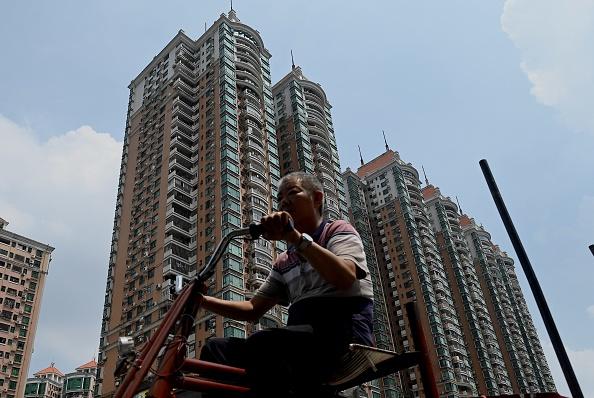
Guangdong has tried to balance development across the province, but the gap has barely changed. Industries moving out of the Pearl River Delta often skip the poorer parts of Guangdong and relocate directly to neighboring provinces such as Jiangxi and Hunan. This shows that the imbalance is rooted in deeper structural issues.
Fifth, Guangdong’s fast urbanization has ended, and the bursting of China’s property bubble has hit the province especially hard. In 1980, Guangdong’s urbanization rate was 21.1 percent, close to the national average. By 2024, it had climbed to 75.9 percent, roughly equal to Japan’s and the United States’ levels in the mid-1970s, indicating that the rapid growth phase is over.
Meanwhile, China’s housing bubble burst in 2021, and the economic downturn still shows no sign of bottoming out. Because Guangdong relies heavily on the property sector—Evergrande and other big developers began there—the damage has been done. From January to July 2025, national real estate investment fell by 12 percent year on year; in Guangdong, it fell by 17.3 percent, a steeper decline than the national average.
Guangdong has long been China’s leading economic engine and, in many ways, reflects the overall national economy. While the issues faced by the province are common across the country, they are more acute in this region.
Are local authorities and the CCP unaware of these issues? Certainly not.
A 2023 provincial government work report states: “Because the province is highly open to the outside world, external shocks have a direct impact. Effective demand is weak, many companies are struggling, new growth drivers are not strong enough, key technologies remain bottlenecked, and regional and urban-rural gaps have not been fundamentally resolved.”
So why has Guangdong failed to transform over the past 20 years?
The core issue lies with the CCP system itself. China’s “lame-footed reforms”—economic changes without political reform—created a distorted market economy dominated by political power and vested interests. Thus, markets cannot function properly.
The CCP’s “wolf-warrior” diplomacy damaged China’s global reputation, pushing the United States and Europe toward “de-risking” and “decoupling.” Beijing’s destruction of Hong Kong’s “one country, two systems” weakened Guangdong’s geopolitical advantage.
In other words, Guangdong’s economic problems are not merely economic—they are systemic. The barriers to transformation lie in the CCP’s policies and political structure. As long as the Communist Party remains in power, Guangdong’s stagnation will not be an exception, but a preview of China’s broader economic future.
What's Your Reaction?
 Like
0
Like
0
 Dislike
0
Dislike
0
 Love
0
Love
0
 Funny
0
Funny
0
 Wow
0
Wow
0
 Sad
0
Sad
0
 Angry
0
Angry
0












Comments (0)