

First Day Results From Beijing: Energy, Soybeans, and an AI Deal in the Making
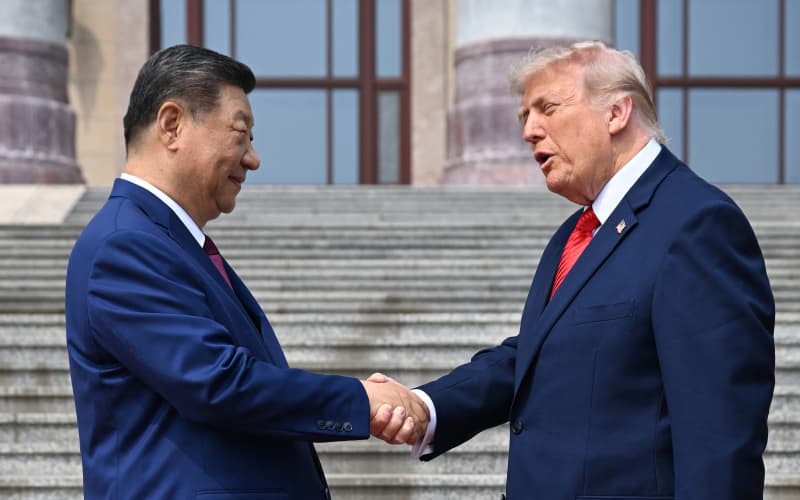
The first day of the Trump-Xi summit in Beijing has produced early signals of progress — but few firm commitments. China's interest in buying more U.S. energy was flagged by American officials, soybean expectations were quietly dialed back, and in a surprise development, the two sides are working on a joint framework to regulate the world's most powerful artificial intelligence systems.


.
Energy: Interest Signaled, Deals Not Yet Signed
After more than two hours of talks at the Great Hall of the People on Thursday, the White House released a readout stating that President Xi Jinping had expressed interest in purchasing more American oil — specifically as a way to reduce China's dependence on oil flowing through the Strait of Hormuz, which has been largely choked off since the outbreak of the U.S.-Iran war in February.
U.S. Treasury Secretary Scott Bessent, speaking to CNBC shortly after the meeting, said energy purchases were discussed, and called Alaskan crude a "natural" fit for Chinese buyers given current market conditions.
The signal is meaningful — but a significant gap remains between interest and action.
China has not imported a single barrel of American oil since May 2025, when a 20-percent retaliatory tariff imposed during the trade war made U.S. crude uncompetitive. Any large-scale resumption of purchases would almost certainly require Beijing to remove that tariff first. And even at its peak — in 2020, following the Phase 1 trade deal of Trump's first term — the U.S. supplied less than four percent of China's total crude imports.
Tellingly, none of the Chinese state media summaries of Thursday's meeting mentioned energy purchases. Beijing's foreign ministry did not respond to a request for comment. That gap between the U.S. and Chinese readouts of the same meeting is itself a signal: what Washington is eager to announce, Beijing is in no hurry to confirm.
The chairman of CNPC, China's state-owned oil giant — which holds long-term contracts with U.S. LNG producers — was among the guests at the state banquet Thursday evening, a detail worth watching as talks continue on Friday.
(For a full breakdown of current U.S.-China energy trade flows and what a deal could look like, see our earlier analysis [here on udumbara.net].)
Soybeans: "All Taken Care Of" — For Now
Treasury Secretary Bessent moved quickly to cool any expectations of a major new soybean commitment emerging from the summit. Referring to the purchase agreement reached at last October's talks in South Korea, he said simply: "Soybeans are all taken care of."
That agreement — known as the Busan commitment — obligates China to import 25 million metric tons of U.S. soybeans annually through 2028, the highest level since 2022. The problem is that China has never publicly confirmed the terms of that deal, and it remains unclear whether the targets apply to calendar or crop years.
China has dramatically reduced its reliance on American soybeans over the past decade. In 2016, the U.S. supplied 41 percent of China's soybean imports. By 2024 that had fallen to around 20 percent, and last year to just 15 percent — with Brazil filling the gap at lower prices.
Markets had hoped the summit might produce a higher buying target. Bessent's comments suggest that will not happen this week. The focus for new agricultural deals has shifted to corn, sorghum, milling wheat, beef, and poultry — products where China has more flexibility and where both sides see room for growth.
For Trump's rural voter base ahead of November's midterm elections, the existing soybean commitment — if China actually honors it — would be meaningful. But "all taken care of" is doing significant work in that sentence.
Artificial Intelligence: The Unexpected Agenda Item
Perhaps the most surprising development from Thursday's talks was the emergence of artificial intelligence as a substantive topic — one that both sides appear genuinely motivated to address.
Bessent confirmed that U.S. and Chinese delegations are working on a joint framework of AI guardrails aimed at preventing non-state actors — criminal organizations, terrorist groups, or rogue actors — from exploiting the most powerful AI models for destructive purposes. The two sides plan to establish a shared protocol for best practices.
The backdrop is significant. Anthropic's newly released Mythos AI system has exposed serious security vulnerabilities in major financial institutions, prompting urgent software upgrades across the U.S. banking sector. Government officials on both sides have raised alarms about the potential for bad actors to exploit frontier AI tools to disrupt markets or the global financial system.
Nvidia CEO Jensen Huang — a last-minute addition to the U.S. delegation at Trump's personal request — is in Beijing for the summit. His company's chips power much of the global AI ecosystem, and Reuters has reported that the U.S. has cleared approximately ten Chinese companies to purchase Nvidia's H200 chips, the company's second most powerful model.
Bessent said he was unaware of those specific approvals, noting that such decisions fall under the Commerce Department rather than Treasury. But he was explicit about the strategic logic: the U.S. is only willing to discuss AI guardrails because it remains ahead.
"We're going to put in U.S. best practices, U.S. values on this, and then roll those out to the world," Bessent said.
That framing — Washington setting the global standard, Beijing agreeing to operate within it — is, if realized, a far more consequential outcome than any soybean tonnage figure.
A First Day of Signals, Not Signatures
What Thursday produced was a set of directions rather than destinations. Energy purchases are on the table — but no tariffs have been lifted. Soybeans are "taken care of" — but the commitment remains unverified. AI guardrails are being discussed — but no framework has been finalized.
The second and final day of the summit takes place Friday, with tea and lunch scheduled between the two leaders before Trump departs for Washington. Whether any of Thursday's signals harden into signed agreements — or whether the summit concludes with what one analyst earlier called "a superficial ceasefire largely to China's advantage" — will become clear within hours.
What is already apparent is that the ground has shifted. Both sides are talking. On some issues, they are even listening. In the current state of U.S.-China relations, that alone is not nothing.
(This article is the fourth in our ongoing series covering the Trump-Xi Beijing summit. Previous articles are available on [udumbara.net/news].)
.
Sources:
- Reuters – "U.S. officials flag prospect of Chinese energy purchases after Trump-Xi meeting" (May 14, 2026): https://www.reuters.com/business/energy/chinas-xi-expressed-interest-buying-us-oil-says-white-house-2026-05-14/
- Reuters – "US's Bessent says soybeans 'all taken care of', cooling expectations for fresh Chinese buying" (May 14, 2026): https://www.reuters.com/world/us/uss-bessent-says-soybeans-all-taken-care-of-cooling-expectations-fresh-chinese-2026-05-14/
- Reuters – "US, China are discussing AI guardrails to safeguard most powerful models, Bessent says" (May 14, 2026): https://www.reuters.com/world/asia-pacific/us-china-are-discussing-ai-guardrails-safeguard-most-powerful-models-bessent-2026-05-14/
.
What's Your Reaction?
 Like
0
Like
0
 Dislike
0
Dislike
0
 Love
0
Love
0
 Funny
0
Funny
0
 Wow
0
Wow
0
 Sad
0
Sad
0
 Angry
0
Angry
0














Comments (0)