

China Pushes Back as Quad Powers Sign Landmark Deals in New Delhi
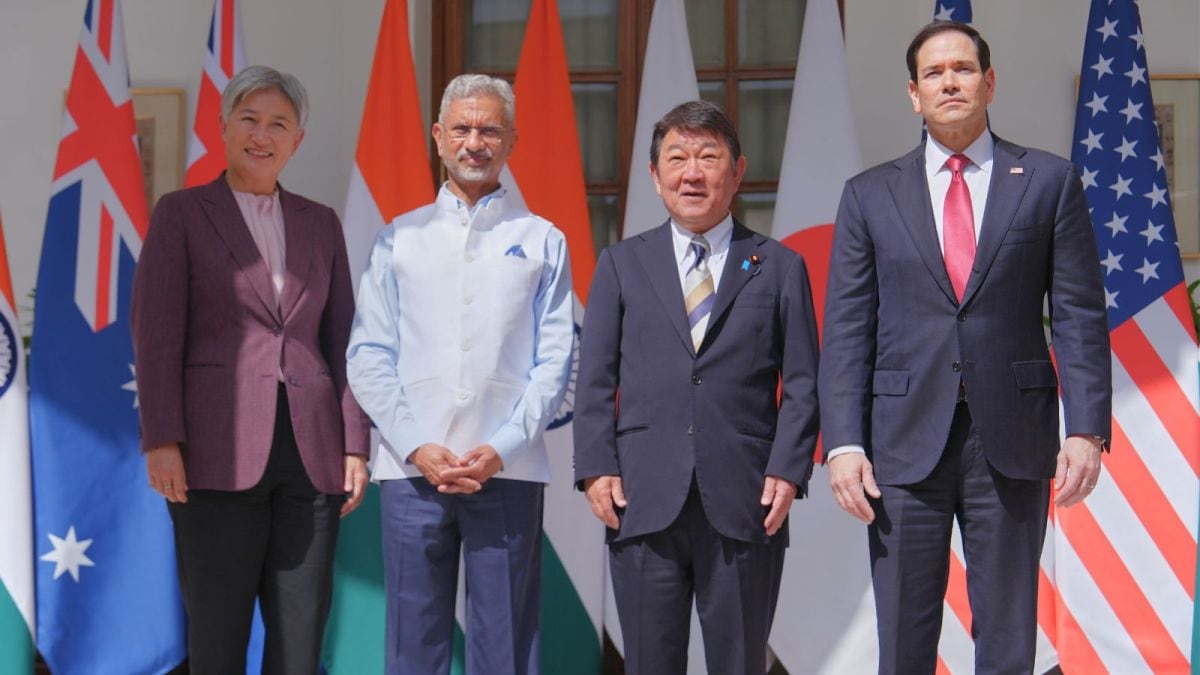
While the foreign ministers of the U.S., India, Japan, and Australia were signing concrete agreements in New Delhi, Beijing moved quickly to voice its objections. China's foreign ministry repeated its standard warning against what it calls exclusive groupings — a thinly veiled critique of the Quad and its expanding agenda.

.
Beijing's Familiar Script
On Tuesday, Chinese foreign ministry spokesperson Mao Ning used her daily press briefing to reiterate Beijing's longstanding position on multilateral cooperation in the Indo-Pacific. Any cooperation between nations, she argued, should contribute to regional peace, stability, and prosperity — and must not be directed against third countries.
She went further, stating that China opposes what she described as exclusive cliques and bloc confrontation, and warned that no cooperative arrangement should undermine mutual trust among countries in the region.
The remarks were diplomatically worded but unmistakably targeted. Beijing rarely names the Quad directly — but no one in the room needed a map.
What the Quad Actually Agreed To
The backdrop to Beijing's statement was a substantive Quad foreign ministers' summit in the Indian capital, where the four nations moved well beyond rhetoric.
U.S. Secretary of State Marco Rubio, India's External Affairs Minister S. Jaishankar, and their counterparts from Australia and Japan agreed to jointly develop a port in Fiji — placing the Quad directly in the middle of an ongoing competition with China for influence across the Pacific Islands. The ministers also signed agreements covering critical minerals and energy security, two sectors where democratic nations have been working to reduce their exposure to Chinese supply chain leverage.
These are not symbolic gestures. They are operational commitments with clear strategic intent.
The Fiji Factor
The decision to co-develop infrastructure in Fiji deserves particular attention. The Pacific Islands have become one of the more active arenas of great-power rivalry in recent years, with China investing substantially in ports, roads, and diplomatic relationships across the region.
The Quad's move into Fiji signals that the grouping is not prepared to cede that space by default. For Australia and Japan — both geographically close to the Pacific and deeply invested in its stability — the agreement carries strategic weight that goes well beyond the construction of a single port.
A Quad That Is Starting to Deliver
China's reaction follows a well-established pattern. Since the Quad was revived in 2017 and significantly upgraded under successive U.S. administrations, Beijing has consistently characterized it as a Cold War-style containment mechanism wearing the language of rules-based order.
Quad members reject that framing. They describe the grouping as a positive, open framework for regional stability — not an anti-China bloc. But the specific nature of Tuesday's agreements — targeting exactly the sectors where China wields the most strategic influence — makes the distinction harder to maintain with a straight face.
What has changed is the Quad's willingness to translate summits into signed deals. When the group moves from aspirational communiqués to concrete infrastructure commitments and resource agreements, the strategic picture shifts meaningfully.
Rubio's Visit: The Bigger Picture
The Quad summit is the diplomatic centerpiece of Rubio's four-day India trip — but it sits within a broader context of renewed U.S.-India engagement. As we reported earlier this week, the secretary's visit to New Delhi has already produced significant momentum: optimism about a future bilateral trade deal, a formal White House invitation extended to Prime Minister Modi, and substantive discussions on energy cooperation and defense ties. (See: Rubio in New Delhi: Trade Optimism, Quad Talks, and a Presidential Invitation for Modi)
The Quad summit adds another dimension to what has been a productive and symbolically rich visit — and reinforces that despite the trade turbulence of earlier this year, the U.S.-India strategic relationship remains central to Washington's Indo-Pacific posture.
What Beijing Is Really Worried About
China's pushback, predictable as it may seem on the surface, reflects a genuine concern. When the Quad moves from statements to signed agreements — on ports, minerals, and energy — it becomes harder for Beijing to dismiss as mere posturing.
The grouping has held three consecutive foreign ministers' meetings without a parallel leaders' summit, a gap that some analysts read as a sign of limited political investment. But Tuesday's outcomes in New Delhi suggest the ministers-level format is becoming increasingly productive in its own right.
Whether Beijing adjusts its approach in response — or doubles down on its current diplomatic objections — remains to be seen. What is clear is that the Quad is no longer just talking. It is building.
.
Sources:
- Reuters – China says Quad cooperation should not target third party (May 26, 2026): https://www.reuters.com/world/china/china-says-quad-cooperation-should-not-target-third-party-2026-05-26/
- Reuters – Australia, India, Japan, US Quad seeks relevance as foreign ministers meet in New Delhi (May 26, 2026): https://www.reuters.com/world/china/australia-india-japan-us-quad-seeks-relevance-foreign-ministers-meet-new-delhi-2026-05-26/
- Council on Foreign Relations – The Quad: What It Is, What It Does (Background): https://www.cfr.org/backgrounder/quad-indo-pacific-alliance
.
What's Your Reaction?
 Like
0
Like
0
 Dislike
0
Dislike
0
 Love
0
Love
0
 Funny
0
Funny
0
 Wow
0
Wow
0
 Sad
0
Sad
0
 Angry
0
Angry
0







Comments (0)