

China Is the Real Militarist in Indo-Pacific: Analysts


.
China is using accusations that Japan seeks to “revive militarism” to mask its own military aggression, which is gravely threatening Indo-Pacific security, experts warn.
Beijing is ramping up efforts to alter the current geopolitical landscape in the region, Japanese Prime Minister Sanae Takaichi said on Feb. 20.
“China is intensifying its attempts to unilaterally change the status quo by force or coercion in the East China Sea and the South China Sea, while also expanding and stepping up its military activities in the areas surrounding our country,” Takaichi told the Diet, Japan’s parliament.
Japan’s Foreign Ministry called the accusations “factually incorrect and baseless” in a statement, and Tokyo has lodged a formal diplomatic protest with China.
The Real Militarist
Robert Eldridge, director of North Asia for the Global Risk Mitigation Foundation in Hawaii, said Wang’s comments were “laughable,” and he characterized the remarks as either completely divorced from reality or a forced recitation of falsehoods.“His comments are masking China’s intentions and actions. It is called projection,” Eldridge told The Epoch Times.
.

Grant Newsham, a retired U.S. Marine officer and former U.S. diplomat, concurred, characterizing Wang’s remarks as empty posturing designed solely to generate noise and attract international attention.
“The regular cries of ‘Japanese militarism’ are a standard feature of Chinese government propaganda whenever Japan makes a prudent effort to improve its defenses or does something China doesn’t like,” Newsham told The Epoch Times.
He added that typically the Japanese themselves would “moderate” whatever they were planning to do to keep China quiet, but the Takaichi administration and most of Japan no longer feel any need to accommodate Beijing.
“While China raises the specter of an aggressive, militarily powerful Japan—which is a lie—it has built up a powerful military that can dominate the Asia region and seize other nations’ territory,” Newsham said.
The Chinese military expansion, he said, continues with an eye towards “global domination.”
China’s Ambitions
Newsham said that Chinese Navy ships, along with the Chinese Coast Guard, maritime militia, and the Chinese fishing fleet functioning as an adjunct of the military, are operating in multiple maritime regions across the Indo-Pacific, threatening regional stability.“The Chinese military and paramilitary presence is so large that the Chinese effectively have de facto control of the South China Sea—which is either international sea—and also other maritime territory that other countries claim,” he said.

“[China] is now tightening its grip on Philippine maritime territory at places like Scarborough Shoal,” Newsham said.
In addition, he warned that Beijing is currently utilizing threatening aerial maneuvers as literal “rehearsals” for a potential invasion of Taiwan—a self-governed democracy that has never been ruled by the Chinese Communist Party (CCP), but which Beijing has vowed to annex by force if necessary.
“The Chinese Air Force is also conducting threatening patrols against Taiwan. Over the last several years, the People’s Liberation Army (PLA) has conducted joint training and exercises all around Taiwan,” Newsham said.
Beyond Taiwan and the South China Sea, he said that Japan is simultaneously facing similar maritime and aerial threats from Beijing.
“PLA has also launched missiles that landed in Japanese waters. The Japanese face constant harassment from Chinese Navy ships and Chinese Air Force fighters and bombers,” Newsham said.
China ‘Wants a Fight’
Kei Koga, an associate professor at the School of Social Sciences at Nanyang Technological University in Singapore, said while China’s strategic posture is not fundamentally new, its implementation now centers on exploiting Taiwan as a wedge to disrupt the broader regional order.“In this context, the anticipated U.S.–China summit in April is likely to be a critical juncture that will signal the future direction of this [U.S.–China–Taiwan] triangular relationship,” Koga told The Epoch Times.
.
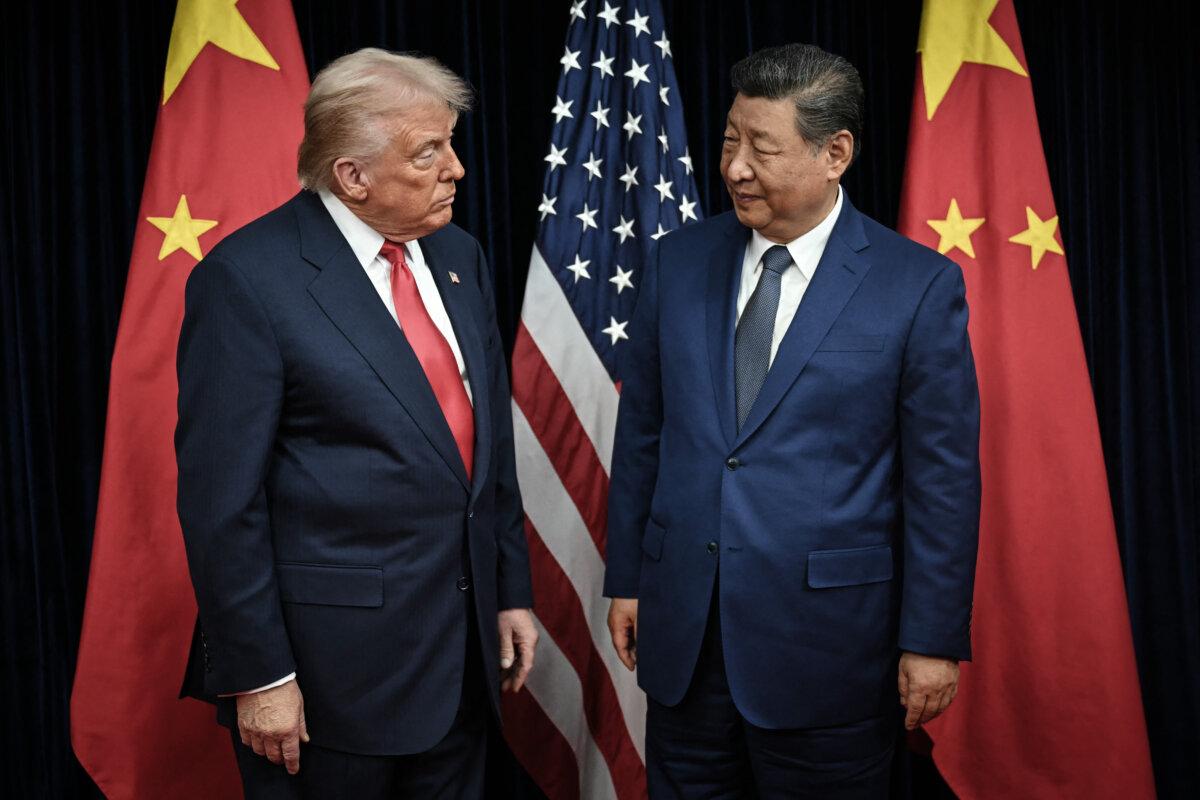
Koga said a military conflict over Taiwan would not be contained locally but would trigger a fundamental shift in the entire regional balance of power.
“It would generate new patterns of alignment and realignment and produce far-reaching strategic consequences for the postwar regional order,” he said.
Newsham said the peril to this regional order stems directly from a proactive desire to initiate conflict.
“If peace is threatened in the Indo-Pacific, it is because China threatens the peace and wants a fight.”
Newsham said Beijing frames its approach to neighboring countries, including Taiwan, Japan, the Philippines, South Korea, and Australia, in ways that leave them little room for compromise.
“So you do whatever China tells you to do—or else fight back,” Newsham said.
He said the burden now falls on Washington to honor its security commitments in the Indo-Pacific and stand by its allies, implying that any retreat would leave the door open for Beijing to fill the void.
“The United States is also having to make a similar choice: defend your position in the Indo-Pacific and protect your friends as you’ve promised to do—and that means fighting—or else slink back, humiliated, to the U.S. mainland,” he said.
.
What's Your Reaction?
 Like
0
Like
0
 Dislike
0
Dislike
0
 Love
0
Love
0
 Funny
0
Funny
0
 Wow
0
Wow
0
 Sad
0
Sad
0
 Angry
0
Angry
0













Comments (0)