

China Defends Iran and Cuba at the UN — Days After Trump Rolled Out the Red Carpet for Xi
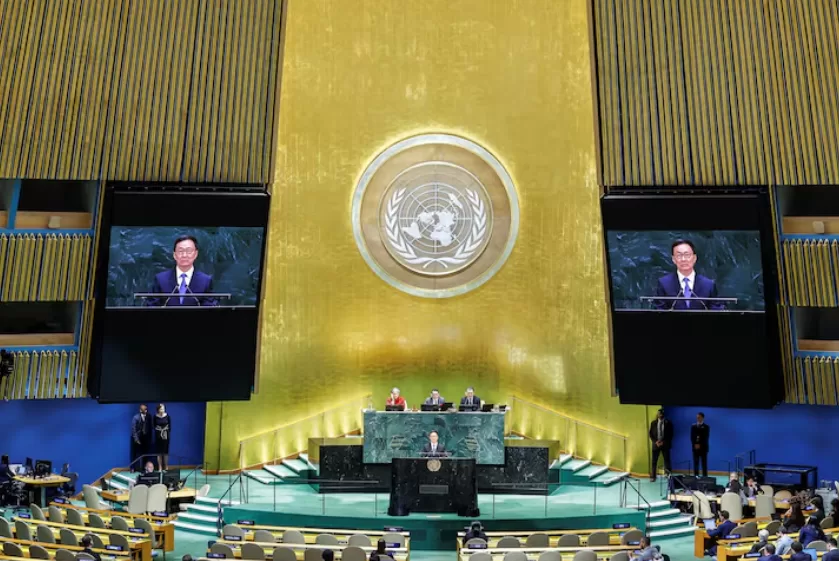
At the United Nations General Assembly on September 26, 2026, Chinese Vice President Han Zheng criticized US pressure on Iran and Cuba without naming Washington directly. The speech came only days after President Trump hosted President Xi Jinping in Washington with a state dinner and military flyovers, exposing a striking gap between diplomatic friendliness and Beijing's real political loyalties.

.
A Speech Full of Hidden Targets
Chinese Vice President Han Zheng addressed the UN General Assembly in New York on Saturday. He never mentioned the United States by name. But the message was clear to anyone following world events: Beijing wants Washington to ease pressure on two of its closest allies, Iran and Cuba.
Han said the "sovereignty and security" of Gulf countries, including Iran, deserve respect. He also demanded that the "relevant country" — understood to mean the US — stop threatening Cuba with force and lift its economic blockade on the island. Neither Iran nor the US were named outright, a common diplomatic tactic Beijing uses to criticize Washington while avoiding direct confrontation.
.
Defending Tehran While Denying Involvement
The remarks on Iran come against a tense backdrop. The war between the US, Israel and Iran began with joint American-Israeli strikes in February 2026. Since then, Washington has accused Beijing of quietly helping Tehran survive the pressure campaign.
According to reports cited by Reuters, China has supplied Iran with shoulder-fired air-defense missile launchers and has helped Tehran find ways around oil sanctions. Just one day before Han's speech, the US ambassador to China said President Trump had personally warned Xi Jinping against supporting Iran during their summit talks — and that Xi gave assurances Beijing would stay out of it.
Han's UN speech suggests those assurances may be worth very little. Calling for Iran's "sovereignty" to be respected while Beijing allegedly arms and financially assists the regime fits a familiar pattern: public neutrality, private support.
.
Cuba's Blackout Crisis Becomes a Talking Point for Beijing
Han also used his speech to demand an end to the US blockade on Cuba. He called on Washington to "immediately and completely" lift sanctions and stop what he described as threats of force against the island.
Cuba has suffered a severe energy crisis for most of 2026. The country's power grid has collapsed multiple times, most recently in a total nationwide blackout in September, leaving millions without electricity. The crisis follows a US-imposed oil blockade that began in January 2026, after Washington cut off fuel shipments tied to Venezuela and pressured Mexico to halt its own deliveries to Havana.
The Trump administration has been explicit about its goal: officials say the sanctions are meant to pressure Cuba's communist government into holding free elections and releasing political prisoners — not simply to punish the population, as Beijing's framing suggests. China, which has never held a free national election itself, positioning itself as a defender of Cuban "sovereignty" is a claim worth examining critically, given Beijing's own record on political freedom at home.
.
A Sharp Contrast to This Week's Washington Summit
Han's combative tone stood in stark contrast to the atmosphere just days earlier in Washington. President Trump hosted Xi Jinping for a three-day state visit that included military flyovers and a lavish state dinner, capping months of improving US-China trade and diplomatic ties following their earlier summit in Beijing in May 2026.
The warmth on display at the White House was widely seen as an attempt by both leaders to stabilize a relationship strained by tariffs, technology restrictions and disagreements over Taiwan. But Han's UN remarks, delivered only 48 hours later, are a reminder that behind the smiles, Beijing continues to align itself with regimes openly hostile to US interests and to the international rules-based order that Washington and its allies support.
.
What Comes Next
Han also portrayed China as a defender of developing nations, saying "all countries, big or small, are equal members of the international community." Critics point out that this rhetoric sits awkwardly alongside Beijing's own record of human rights abuses, including its long-documented persecution of religious and spiritual groups such as Falun Dafa practitioners, its treatment of Uyghurs, and its suppression of dissent in Hong Kong.
For Washington, the speech is unlikely to change course. The Trump administration has shown no sign of easing sanctions on Cuba or halting military pressure on Iran, and officials are likely to view Han's comments as further confirmation that China's stated assurances on Iran cannot be taken at face value.
.
Sources
- Associated Press (AP) — https://abc17news.com/?p=1217432
- Al Jazeera, "Cuba's power grid collapses again, triggering third blackout in 10 days" — https://www.aljazeera.com/amp/news/2026/7/14/cubas-power-grid-collapses-again-triggering-third-blackout-in-10-days
- Agence France-Presse (AFP), via Ahram Online, "Cuba suffers new nationwide blackout, third in six months" — https://english.ahram.org.eg/News/572333.aspx
- NOTUS, "State Dinner in the Works for Chinese President Xi Jinping's Visit to D.C." — https://www.notus.org/trump-white-house/state-dinner-china-president-xi-jinping-visit-washington-dc
.
What's Your Reaction?
 Like
0
Like
0
 Dislike
0
Dislike
0
 Love
0
Love
0
 Funny
0
Funny
0
 Wow
0
Wow
0
 Sad
0
Sad
0
 Angry
0
Angry
0












Comments (0)