

Xi's Purge Machine: Two New Generals Rise as China's Military Command Crumbles from Within
Chinese leader Xi Jinping has promoted two senior officers to the PLA's highest active-duty rank, installing veteran anti-graft enforcer Zhang Shuguang as the military's new top corruption watchdog. The move comes as Xi's years-long purge has hollowed out China's supreme military command to just two men, raising serious questions about the People's Liberation Army's actual combat readiness.

.
A Ceremony That Reveals a Crisis
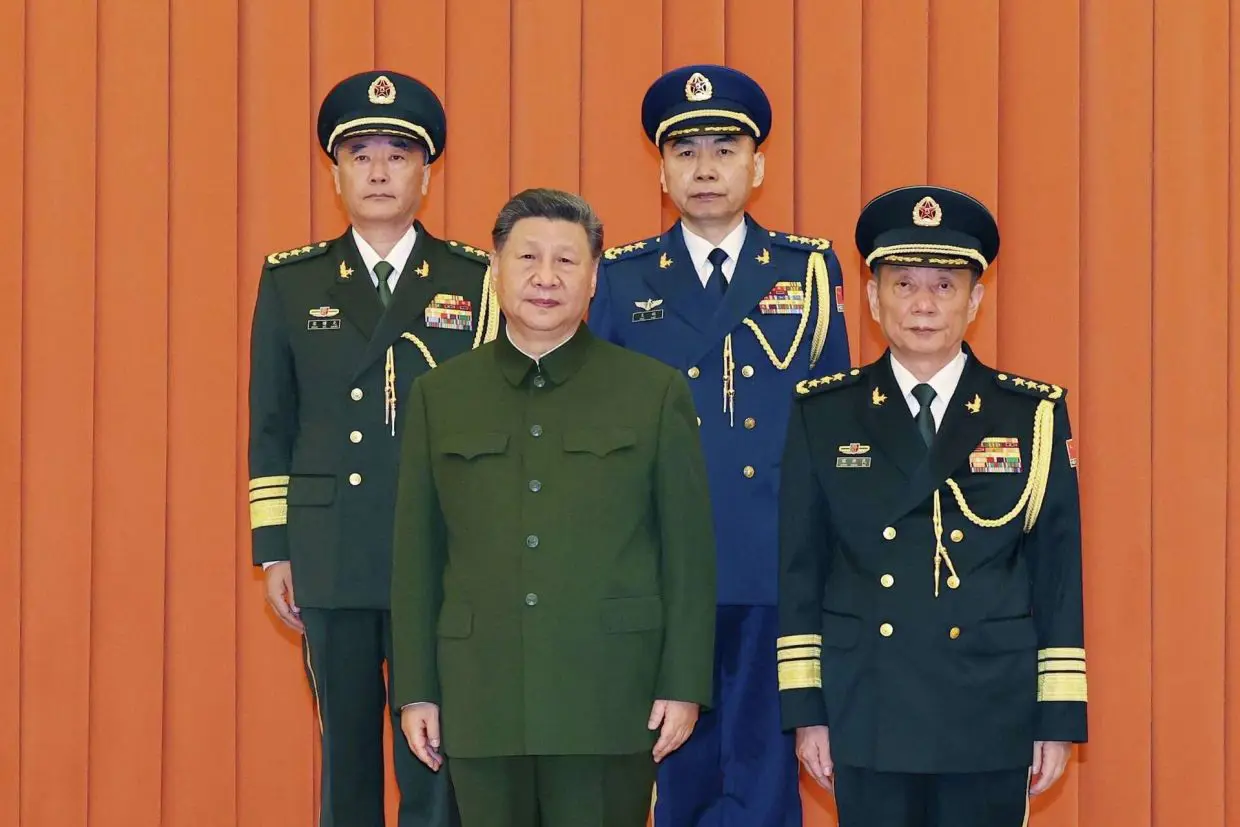
On July 3, Chinese President Xi Jinping presided over a promotion ceremony in Beijing, elevating two officers to the rank of general — the highest grade available to active-duty personnel in China. On the surface, it looked like routine military business. Underneath, it exposed how deeply Xi's own anti-corruption campaign has damaged the institution he depends on most.
Zhang Shuguang, a career anti-graft officer, was named secretary of the Central Military Commission's (CMC) Discipline Inspection Commission — effectively the military's internal police force. He replaces Zhang Shengmin, who had held the post since 2017 and was only recently promoted to CMC vice-chairman. Wang Gang, the second officer promoted, takes over as commander of the PLA Air Force.
.
A Command Structure Reduced to Two People
The scale of the underlying purge is difficult to overstate. China's supreme military decision-making body, the CMC, was designed to have seven members. Today, after years of investigations, disappearances, and prosecutions, it effectively consists of just two: Xi himself and Zhang Shengmin.
Among the highest-profile casualties were two former defense ministers, Wei Fenghe and Li Shangfu, who were handed suspended death sentences in May 2026 (a sentence in China that is almost always commuted to life imprisonment). Earlier this year, CMC Vice Chairman Zhang Youxia and Chief of Staff Liu Zhenli were also placed under investigation for what state media described as "serious violations of discipline" (a euphemism Chinese authorities commonly use to describe corruption or disloyalty cases).
.
"Turn the Blade on Oneself"
Facing a leadership vacuum of his own making, Xi took an unusual step in April: he sent the PLA's remaining senior officers to an intensive ten-week political retraining course in Beijing. There, officers studied Xi's political writings, revisited their Communist Party oaths, and were reportedly pushed to confess personal failings late into the night.
State media described the goal as encouraging officers to "turn the knife's blade on oneself" and root out what was called "contamination by pernicious influence" — party language for disloyalty or corrupt behavior. The choice of words underscores how the campaign functions less as ordinary law enforcement and more as a mechanism of ideological control, a hallmark of one-party rule that leaves little room for independent oversight or due process.
.
Why This Matters Beyond China
Analysts say Xi's calculation is that short-term pain will produce a more obedient and reliable fighting force in the long run. Neil Thomas, a fellow at the Asia Society Policy Institute, said tighter political control is meant to make the PLA a more credible tool of pressure against Taiwan and in the South China Sea, even if purges hurt near-term readiness — a trade-off Xi appears willing to accept.
That calculation matters well beyond China's borders. A military leadership under constant internal suspicion may struggle to coordinate effectively in a real crisis, but a system built on personal loyalty to one leader is also, by nature, less predictable and less accountable — a concern shared by democracies watching the region, including the United States under the current administration, which has kept a close eye on Beijing's military posture toward Taiwan.
.
What Comes Next
The current CMC lineup was installed in October 2022 and is expected to be reshuffled after the Communist Party's next five-yearly congress, likely in autumn 2027. Until then, the promotions of Zhang Shuguang and Wang Gang suggest Xi is prioritizing personal trust over institutional experience — a pattern that has defined his military reshuffles for more than a decade, and one that shows no sign of slowing down.
.
Sources:
- https://www.scmp.com/news/china/military/article/3359334/chinese-leader-promotes-2-generals-wake-military-anti-corruption-probe
- https://www.bloomberg.com/news/articles/2026-07-03/xi-replaces-anti-corruption-leader-in-purge-of-china-s-army
- https://www.scmp.com/news/china/military/article/3359206/what-seating-chart-might-reveal-about-future-chinas-military-leadership
- https://en.wikipedia.org/wiki/Anti-corruption_campaign_under_Xi_Jinping
.
What's Your Reaction?
 Like
0
Like
0
 Dislike
0
Dislike
0
 Love
0
Love
0
 Funny
0
Funny
0
 Wow
0
Wow
0
 Sad
0
Sad
0
 Angry
0
Angry
0












Comments (0)