

US–China Competition Intensifies During Trump’s Asia Trip as Beijing Courts Nations


.
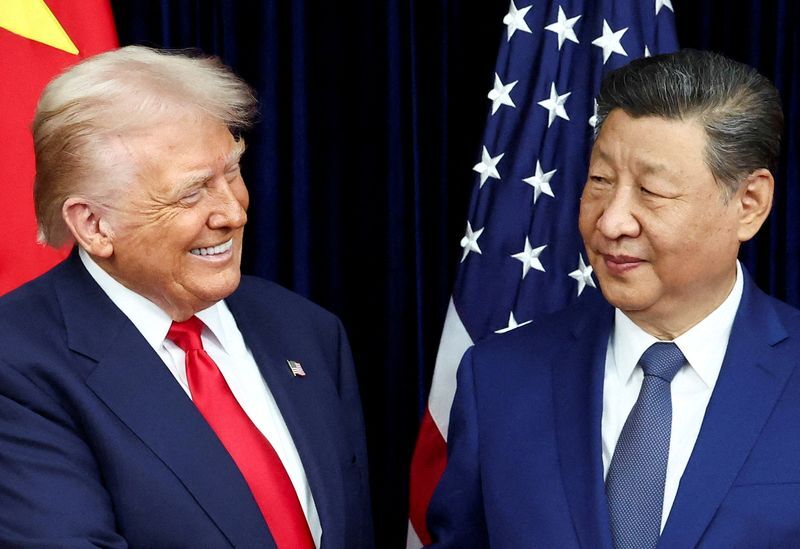
U.S. President Donald Trump has signed deal after deal during an Asia tour that will culminate with a meeting with Chinese Communist Party (CCP) leader Xi Jinping this week. Meanwhile, Beijing is trying to drive a wedge between Asian nations and the United States as Chinese officials seek their own trade deals.
The trip is bookended by two major Asian summits—ASEAN in Malaysia and APEC in South Korea—allowing for potential meetings with dozens of nations on the sidelines.
ASEAN Deals
Trump’s arrival in Malaysia on Oct. 26 coincided with the start of the Association of Southeast Asian Nations (ASEAN) summit, where he oversaw the signing of a peace deal he helped broker between Thailand and Cambodia.Malaysia will give preferential access to U.S. agricultural goods and reduce barriers to entry for U.S. cars. Malaysia also agreed to make various U.S. purchases in energy and tech: liquid natural gas worth $3.4 billion annually from the United States; $42.6 million annually in coal; $119 million in telecommunications products; 30 Boeing aircraft; and U.S. semiconductors, aerospace components, and data center equipment worth $150 billion.
The United States and Malaysia upgraded their relationship to a Comprehensive Strategic Partnership for the first time, enabling cooperation on maritime security.
Cambodia will eliminate all tariffs on U.S. goods. The United States and Cambodia also reached a security agreement, with the United States lifting an arms embargo on Cambodia, increasing the number of seats for Cambodian officers at U.S. military colleges, and both sides agreeing to restart joint defense exercises. Cambodia also agreed to work with the United States on combating transnational crime, including drug trafficking and online scam rings.
Thailand agreed to eliminate most tariffs on all U.S. industrial, food, and agricultural goods. It also agreed to enhance cooperation with the United States on investigating online scam rings.
ASEAN’s 11 members also comprise China’s biggest trading partner, with bilateral trade totalling $771 billion last year.
In Trump’s absence, Chinese Premier Li Qiang on Oct. 27 gave a speech at the ASEAN summit, urging member nations to come together to stand up to “protectionism” and tariffs, and “promote reform” in the global governance system.
Trump has said that the tariffs were imposed to address growing trade deficits and other countries’ trade barriers that are unfair to the United States, and in China’s case, to stem the country’s export of fentanyl precursors, which the U.S. president said have fueled the opioid crisis in America.
The Philippines, which is set to become the next ASEAN summit chair for 2026, challenged Beijing’s statements of wanting peace when Philippine President Ferdinand Marcos Jr. raised instances of Chinese aggression on Philippine vessels in the South China Sea.
On the last day of the summit on Tuesday, the bloc signed a 3.0 version of its free trade agreement with China that covers new sectors, including digital and green economies.
“The upgrade will further reduce trade barriers, strengthen supply chain connectivity, and unlock opportunities in future growth areas,” Singaporean Prime Minister Lawrence Wong said.
Critical Minerals
Beijing’s move earlier this month to issue sweeping restrictions on rare earths heightened global tensions ahead of the Trump–Xi meeting.Trump countered that China’s hold on rare earths isn’t the leverage many think it is, if Beijing’s use of those as leverage would come at the cost of doing any business with the United States.
Trump has accelerated diversifying the supply chain away from China in his second term, and said after signing a critical minerals agreement with Australia on Oct. 20 that “in about a year from now, we’ll have so much critical mineral and rare earth that you won’t know what to do with them.”
According to U.S. trade negotiators, Beijing is set to agree to delay rare-earth restrictions for a year as it reviews the policy.
Trump has also signed critical mineral agreements with Thailand, Malaysia, and Japan during his trip.
The memorandums of understanding with Thailand and Malaysia allow for information sharing, investments, and cooperation that could include joint geoscience work, workshops, academic seminars, and measures to protect industries from non-market and unfair trade practices.
Japan’s Hawkish Prime Minister
Japan’s newly elected prime minister, Sanae Takaichi, has said that the United States is Japan’s most important ally and voiced support for Taiwan, a highly sensitive issue for the Chinese regime.Trump told Takaichi the United States would be Japan’s “ally at the strongest level.”
On Tuesday, Trump addressed American troops aboard the aircraft carrier USS George Washington at the Yokosuka naval base in Japan, and Takaichi was in attendance.
“The free, open, and stable international order that we were accustomed to is violently shaken in the face of historic change of power balance and intensifying geopolitical competitions,” Takaichi said in her speech.
“In the region around Japan, military activities and other actions from our neighbors China, North Korea, and Russia are causing grave concerns.”
As the Chinese regime increases its aggression in the Indo-Pacific, it has come up against or even briefly encroached on Japanese territory more than once in recent years.
On Tuesday, Chinese Foreign Minister Wang Yi had a phone call with Japanese Foreign Minister Toshimitsu Motegi, seeking to advance bilateral ties with “high-level exchanges” and raising the issue of deferring to Beijing on Taiwan, according to Chinese state media outlet Global Times.
The Japanese readout of the call did not mention a potential meeting between Takaichi and Xi.
Motegi said he shared the goal of building a “constructive and stable Japan–China relations.”
He also expressed several concerns, including Beijing’s rare earth export controls, military aggression near Japan’s Senkaku Islands, import restrictions on Japanese beef in China, and increased violence against Japanese in China.
“It’s an exciting new era in the U.S.–Japan relationship, but it’s built on the foundation of decades of working together, and now it’s being modernized to reflect the challenges of a new era that we’re going to confront together, like we’ve confronted the challenges for the last 80 years,” Rubio said.
When Xi Jinping arrives in South Korea for APEC, he is expected to meet with South Korean President Lee Jae Myung on Nov. 1. Chinese spokespersons said there would be several other meetings with heads of state, but did not specify which nations.
What's Your Reaction?
 Like
0
Like
0
 Dislike
0
Dislike
0
 Love
0
Love
0
 Funny
0
Funny
0
 Wow
0
Wow
0
 Sad
0
Sad
0
 Angry
0
Angry
0












Comments (0)