

US-Japan Partnership Enters ‘New Golden Age’ Amid Regional Tensions


.
U.S. President Donald Trump met with Japanese Prime Minister Sanae Takaichi during his visit to Japan from Oct. 27 to 29, during which new rare-earth deals and expanded investments were announced to mark what both leaders called a “new golden age” of the U.S.–Japan alliance.
While the visit drew scrutiny from China’s Foreign Ministry, analysts say the summit reaffirmed Washington’s strategic focus on containing Beijing’s influence across the Indo-Pacific.
Renewed Alliance
On Oct. 28 in Tokyo, Trump met with Takaichi at the Akasaka Palace before the two boarded the Marine One presidential helicopter for the Yokosuka Naval Base, where they toured the aircraft carrier USS George Washington.Addressing 6,000 U.S. service members stationed in Japan, Trump announced the first delivery of U.S.-made missiles to Japan’s Self-Defense Forces.
The president referred to Takaichi as a great friend and reaffirmed America’s alliance with Japan.
.
“The cherished alliance between the United States and Japan is one of the most remarkable relationships in the entire world,” Trump said.
“Born out of the ashes of a terrible war, our bond has grown over eight decades into the beautiful friendship that we have. It’s a foundation of peace and security in the Pacific.”
Takaichi responded by pledging to keep the Indo-Pacific region “free and open” and to strengthen Japan’s defense capabilities.
“Now we are facing an unprecedented, severe security environment,” she said.
.
“Peace cannot be preserved by words alone—it can only be protected through unwavering determination and action.”
Both leaders have instructed their ministers and secretaries to take further steps to implement a “new golden age” partnership.
.
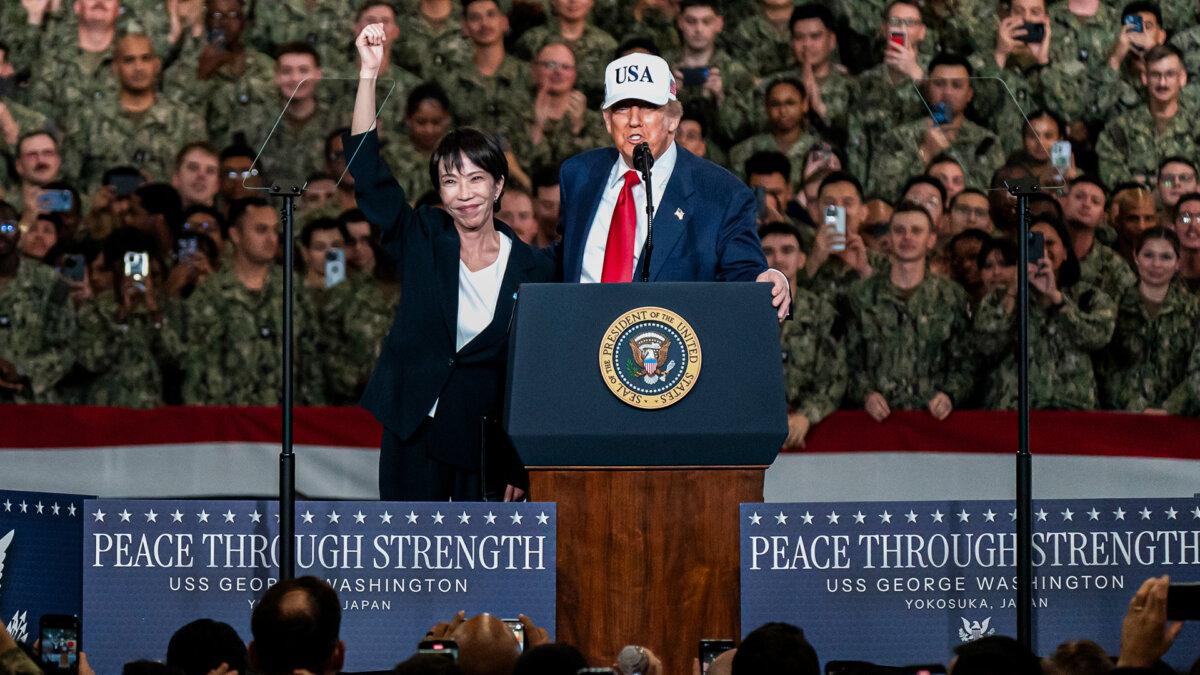
Japanese Prime Minister Sanae Takaichi waves as U.S. President Donald Trump speaks aboard USS George Washington in Yokosuka, Japan, on Oct. 28, 2025. Tomohiro Ohsumi/Getty Images
.
Analysts See Strategy to Contain China
Su Tzu-yun, a research fellow at Taiwan’s Institute for National Defense and Security Research, said the Trump–Takaichi meeting reaffirmed Washington’s strategic commitment to counter Beijing.“At the broader strategic level, Trump’s return to APEC and his diplomatic achievements with ASEAN—especially in rare earth cooperation—suggest that some of China’s traditional allies are now loosening their alignment with Beijing,” Su told The Epoch Times.
.
He noted that the Trump–Takaichi meeting was exceptionally cordial, particularly Trump’s invitation for Takaichi to board Marine One and tour the USS George Washington—a gesture that underscored their close rapport.
.
Su added that with U.S. allies in the Indo-Pacific region—including South Korea, the Philippines, and Australia—coordinating more closely with Japan, China’s regional influence is increasingly constrained.
.
Even countries such as Vietnam, Burma (also known as Myanmar), and Laos, once considered friendly to Beijing, are now cooperating with the United States on rare earth supplies—a shift Su called “a strategic reversal for China.”
Japan Steps Out of Postwar Shadow
Akio Yaita, director of the Indo-Pacific Strategy Think Tank (IPST) and a veteran Japanese journalist based in Taiwan, said Trump’s support for the late Japanese Prime Minister Shinzo Abe’s policies, known for his pro-Taiwan, anti-Chinese-regime stance, signaled Japan’s reemergence as a stronger security partner.“The rare earth agreement not only reduces Japan’s dependence on China,” he told The Epoch Times, “it also allows the country to step out of the postwar non-military shadow.”
U.S.-based China affairs commentator Tang Jingyuan agreed, saying the U.S.–Japan alliance “has never been stronger.”
.
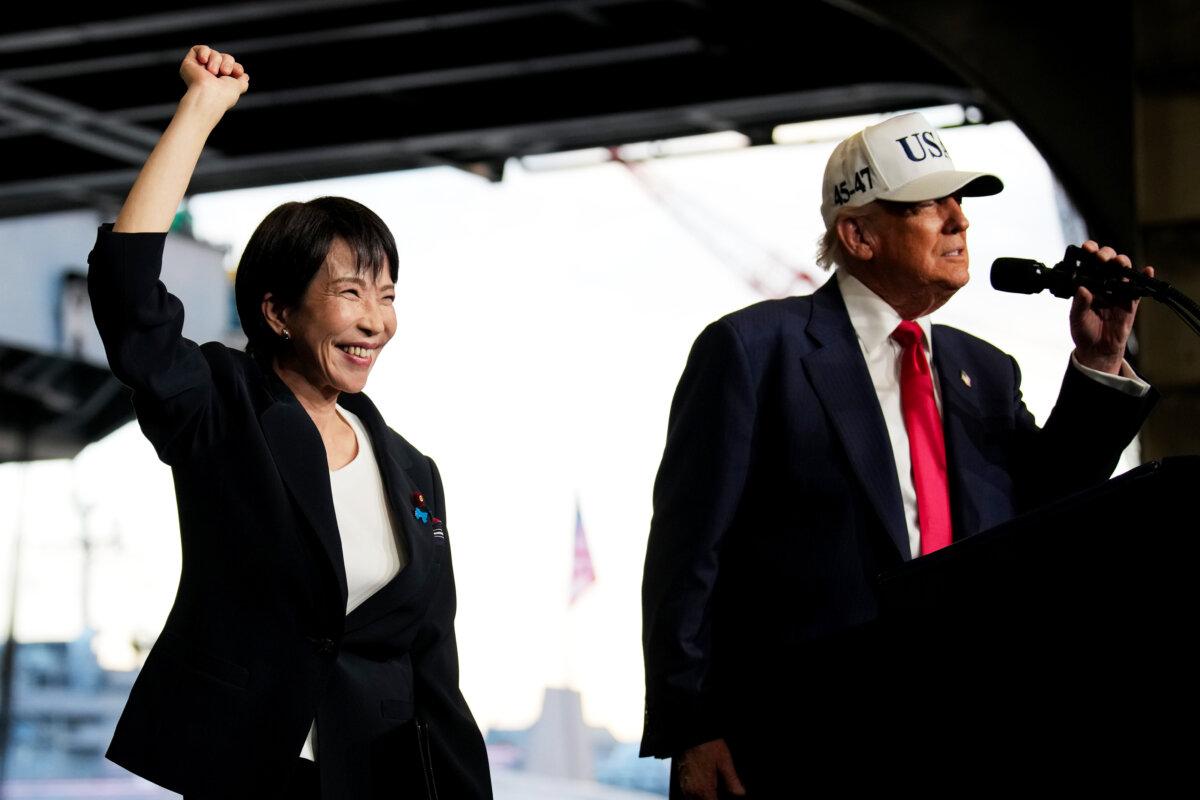
Japanese Prime Minister Sanae Takaichi and U.S. President Donald Trump speak to troops aboard USS George Washington at Fleet Activities Yokosuka in Yokosuka, Japan, on Oct. 28, 2025. Andrew Harnik/Getty Images
.
He suggested that Takaichi may seek to amend Japan’s pacifist constitution to expand the country’s military capabilities and rebuild its national defense.
“Trump’s Indo-Pacific strategy is very clear,” Tang told The Epoch Times.
“He views Japan as his top-priority ally. In the Indo-Pacific region, Japan’s position is comparable to that of the UK in Europe as America’s key partner. The U.S.-Japan alliance will serve as a cornerstone of the entire Indo-Pacific strategy.”
China Pushes Back
Beijing reacted sharply to the visit. Chinese Foreign Ministry spokesperson Guo Jiakun criticized the U.S.–Japan security cooperation and urged Japan to “respect neighboring countries’ security concerns” and to “reflect deeply on its [World War II] history.”Yaita dismissed the comments as hollow rhetoric.
.
“These [talking points] have been repeated by China for decades,” he said. “The country undermining regional peace is China itself.”
Tang added that Beijing opposes any expansion of Japan’s military capabilities because it threatens China’s ambitions for regional dominance in the Indo-Pacific.
“If Japan significantly increases defense spending, it would greatly constrain China, especially if conflict arises over Taiwan,” he said.
The Taiwan Factor
During her meeting with Trump, Takaichi reaffirmed the importance of peace and stability in the Taiwan Strait.Su emphasized that Taiwan’s security is vital to Japan’s survival.
.
“Ninety-two percent of Japan’s energy supplies pass through the Taiwan Strait, and nearly all exports to Europe also transit that route,” he said.
“For leaders like Takaichi, South Korean President Lee Jae Myung, and Trump, Taiwan is critical not just for semiconductors but for its irreplaceable geostrategic position.”
Su added that U.S.–China relations now represent a reversal of the Nixon-era strategy.
.
While Nixon sought to use China to counter the Soviet Union, today, the United States and its allies in NATO and East Asia are working together to contain Beijing.
Su said stabilizing Taiwan remains a top U.S.–Japan priority.
.
“China faces serious internal challenges, reducing the likelihood of military action against Taiwan,” Su said.
“Beijing is more likely to attempt unification through political influence—but that does not align with U.S.–Japan security interests. Taiwan must seize this strategic moment to strengthen its defense capabilities.”
.
Ning Haizhong and Luo Ya contributed to this report.
.
What's Your Reaction?
 Like
0
Like
0
 Dislike
0
Dislike
0
 Love
0
Love
0
 Funny
0
Funny
0
 Wow
0
Wow
0
 Sad
0
Sad
0
 Angry
0
Angry
0













Comments (0)