

Typhoon Bavi Slams Into Eastern China After Nearly 2 Million Evacuated Across the Region
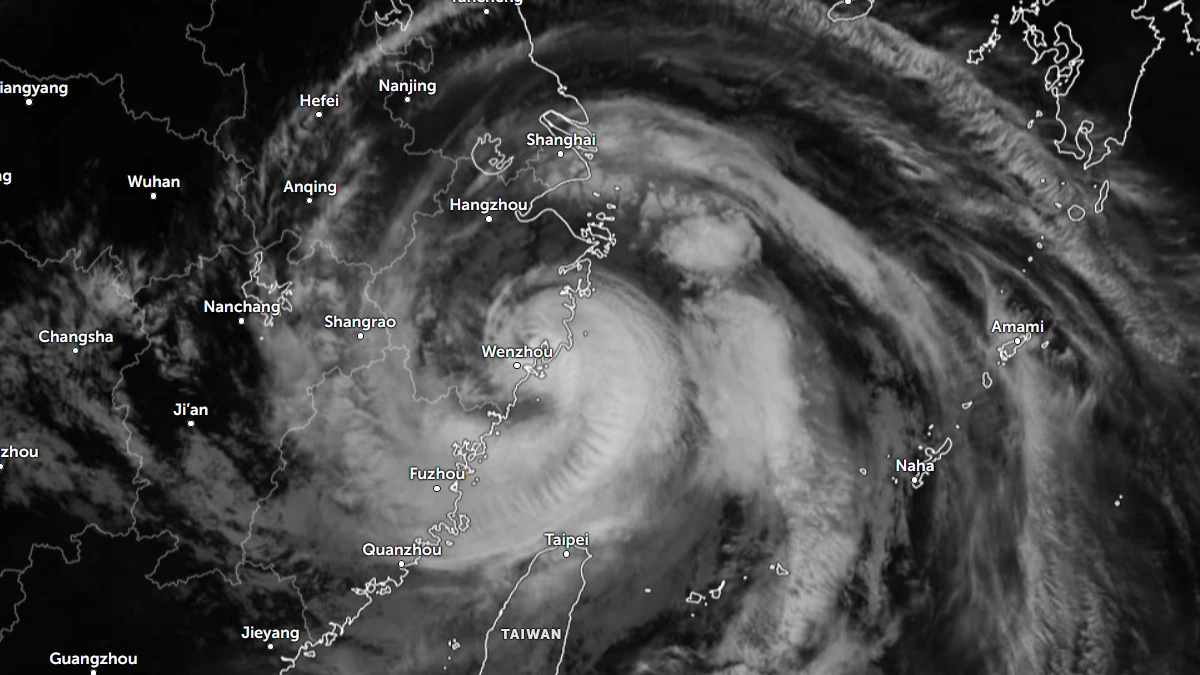
Typhoon Bavi made landfall in eastern China's Zhejiang province on Saturday night after tearing across the Philippines, the Northern Mariana Islands, Okinawa and Taiwan over the past two weeks. Chinese authorities evacuated close to 2 million people, while the storm's earlier rampage through the Philippines has killed at least 17 people and left several more missing. Hundreds of flights were grounded in Taiwan and Japan as the massive system, roughly the size of France, pushed across the region.

.
Landfall in Taizhou
Typhoon Bavi came ashore late Saturday near the city of Taizhou in China's Zhejiang province, packing sustained winds of around 144 km/h (90 mph) — comparable to a Category 1 hurricane. The storm made landfall at around 11:20 p.m. local time.
Chinese state media reported that more than 1.7 million people were evacuated across Zhejiang province, with over 100,000 more moved out of neighbouring Fujian province and Beijing, and roughly 34,000 evacuated from Shanghai. In total, evacuation efforts across the country approached 2 million people.
Despite the scale of the storm, some residents in the storm's path stayed calm. One Wenzhou resident said he was only mildly worried, noting his family had experience with typhoons and had stocked a few days' worth of water, adding there was no need to panic or hoard supplies.
By the time it reached the Chinese mainland, Bavi had already weakened considerably from its peak. Weather trackers reported that the storm had earlier maintained super typhoon intensity over the Philippine Sea, with winds of up to 250 km/h, before beginning a gradual weakening trend as it approached Taiwan.
.
A Storm the Size of a Country
What made Bavi especially dangerous was not just its wind speed but its sheer size. Meteorologists described the storm's cloud shield as "gargantuan," measuring more than 1,000 km across according to the US Joint Typhoon Warning Center — an area nearly nine times the size of Zhejiang province.
Forecasters had earlier warned that Bavi would be the largest storm by size to hit Taiwan since 1987, with storms of comparable scale described as rare in recent years. Scientists pointed to the storm's unusually long life over open water as a key factor. Imperial College London tropical cyclone researcher Xiangbo Feng noted that Bavi had spent an extended period intensifying over the Pacific, drawing energy from warm ocean waters and building up large amounts of moisture.
.
Taiwan Shuts Down
Ahead of landfall in China, Bavi skirted north of Taiwan without making direct landfall on the island — but the disruption was still severe. Taiwanese authorities evacuated more than 14,000 people, mostly from mountainous areas, as a precaution against forecasts of nearly a metre of rain in some regions.
Air travel was hit hardest. Roughly 920 international flights were cancelled, effectively shutting down Taipei's main international airport at Taoyuan, along with all 282 domestic flights. Nearly every city and county in Taiwan declared a storm holiday, closing offices and schools that would otherwise have been open on the weekend.
By the storm's later stages, Taiwanese authorities had recorded a broader toll from the multi-day weather event. According to Wikipedia's aggregated incident reports citing Taiwanese fire authorities, Bavi brought prolonged heavy rainfall and flooding to northern Taiwan, resulting in 87 injuries, with over 1,450 reported incidents of damage and more than 700 fallen trees. Most injuries came from falls, rather than direct storm impact.
.
Deadly Toll in the Philippines
While Taiwan, Japan and China avoided fatalities directly tied to the typhoon itself, the picture was far grimmer in the Philippines, where Bavi — locally named "Inday" — combined with an already-active monsoon system to trigger fatal landslides.
At least 17 people died in the Philippines due to heavy rains intensified by the storm's approach. Later reporting indicated the toll climbed further as flooding and landslides continued. A landslide in the village of Pandaw, worsened by soil already weakened by a recent earthquake in Mindanao, killed 10 people, while a separate landslide in Lanao del Sur killed seven more and left four missing.
The Philippines' National Disaster Risk Reduction and Management Council reported that the combined effects of the typhoon and the seasonal monsoon known locally as "habagat" affected over half a million people nationwide.
.
Okinawa and the Wider Pacific
Before reaching Taiwan and China, Bavi's outer bands lashed Japan's southern Sakishima and Yaeyama island chains. In Okinawa Prefecture, the storm caused five minor injuries and prompted the evacuation of nearly 83,000 people.
Bavi's earlier path was even more destructive. Before weakening on its approach to East Asia, the system passed directly over the US territory of Rota in the Northern Mariana Islands at peak intensity in early July, with the Japan Meteorological Agency estimating maximum sustained winds of 205 km/h and a central pressure of 910 hPa, causing major damage to the island's infrastructure. Local emergency crews prioritised restoring water access and clearing roads to shelters, fire stations, ports and the airport in the storm's aftermath.
.
Outlook
Chinese meteorological authorities have warned that the danger is not over simply because Bavi made landfall. Forecasters cautioned that inland provinces further from the coast should brace for a second wave of heavy rain in the days following landfall, as the weakening storm system continues to track northwest across the mainland before dissipating.
For Taiwan and the Philippines, the recovery effort is now shifting from storm response to cleanup and, in the hardest-hit Philippine communities, search operations for those still missing. Authorities in the region are also monitoring whether the unusually large size of storms like Bavi — echoing a pattern of increasingly powerful cyclones seen in recent typhoon seasons — reflects a longer-term shift tied to warming Pacific waters.
.
Sources
- Reuters (Go Nakamura, Xihao Jiang, Ella Cao) – "Typhoon Bavi makes landfall in eastern China's Taizhou after nearly 2 million evacuated", July 11, 2026 — https://www.reuters.com/business/environment/thousands-evacuated-taiwan-shuts-down-typhoon-bavi-2026-07-11/
- Taipei Times – "Typhoon Bavi to be largest storm hitting Taiwan since 1987", July 9, 2026 — https://www.taipeitimes.com/News/taiwan/archives/2026/07/09/2003860479
- The Watchers – "Typhoon Bavi to bring extreme rain to Taiwan before landfall in eastern China", July 9, 2026 — https://watchers.news/2026/07/09/typhoon-bavi-to-bring-extreme-rain-to-taiwan-before-landfall-in-eastern-china/
- Wikipedia (aggregated, sourced to PAGASA, Taiwan fire authorities, and Philippine News Agency) – "Typhoon Bavi (2026)" — https://en.wikipedia.org/wiki/Typhoon_Bavi_(2026)
.
What's Your Reaction?
 Like
0
Like
0
 Dislike
0
Dislike
0
 Love
0
Love
0
 Funny
0
Funny
0
 Wow
0
Wow
0
 Sad
0
Sad
0
 Angry
0
Angry
0














Comments (0)