

Rare Tornadoes and Record Floods Kill Dozens Across Central China as Super Typhoon Looms
Two rare tornadoes tore through China's Hubei province on Monday night, killing at least 11 people and injuring hundreds more. The disaster struck alongside deadly flooding in southern China and a landslide in the west, as authorities now brace for Super Typhoon Bavi, expected to make landfall this weekend.

.
A Night of Destruction in Hubei
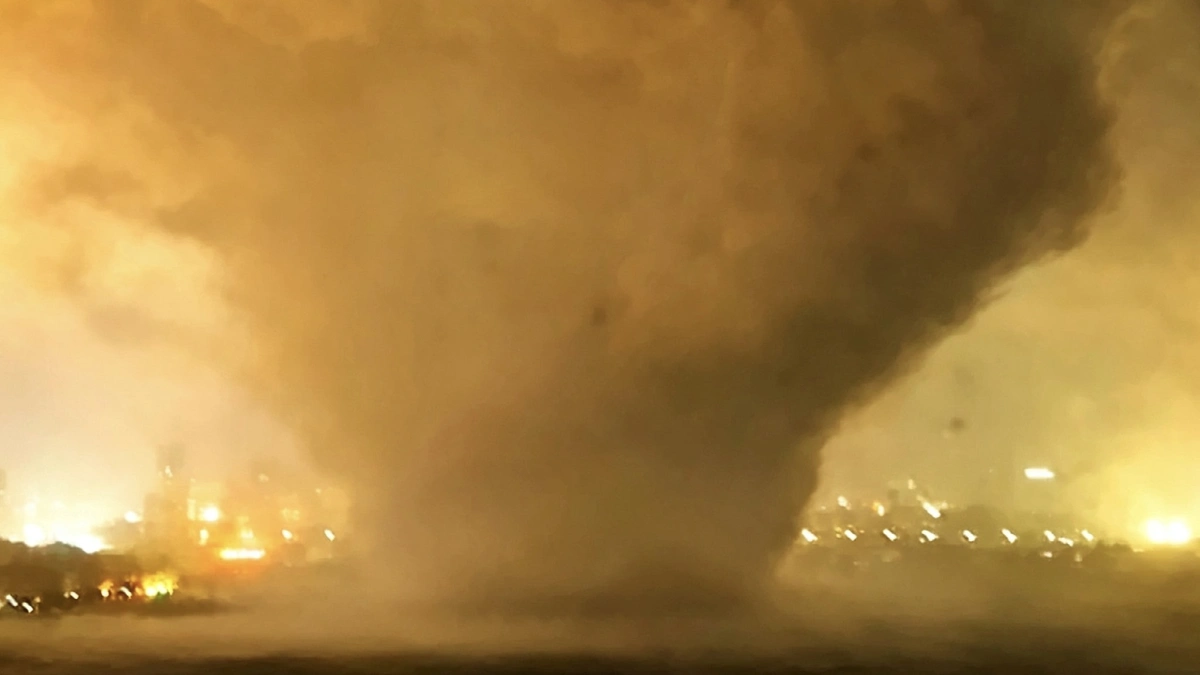
Two tornadoes swept across Hubei province in central China on Monday evening, cutting through the cities of Huangshi, Huanggang, Ezhou and Xianning over roughly four hours. Wind speeds reached up to 149 kilometers per hour (93 mph), classified as level 13 on the extended Beaufort scale.
At least 11 people were killed and more than 330 injured, according to figures released by Hubei's emergency management authorities on Tuesday. One person remained missing. Some outlets later reported a rising toll, with local media citing up to 15 deaths as rescue crews continued assessing the damage — a reminder that early disaster tolls in China are frequently revised in the following days.
More than 20 houses collapsed outright, and upward of 4,800 additional buildings were damaged. Roughly 14,600 people were affected in total, with hundreds evacuated to safety.
.
Eyewitness Accounts of the Storm
The destruction was severe enough that a man was reportedly pulled from his 12th-floor apartment in Huanggang, along with pieces of his furniture, as winds tore through the building. He is now in intensive care.
In Huanggang, a logistics warehouse was badly hit, with several heavy trucks lifted and thrown up to 30 meters (98 feet) by the wind. Video footage showed a large funnel cloud moving over a lake before striking populated areas, while other clips showed vehicles crushed by twisted sheets of metal torn from nearby roofs.
Residents described the shock of the storm. Windows shattered, furniture was thrown across rooms, and balconies were torn open within minutes, according to local accounts carried by Chinese media.
.
Why Tornadoes in Hubei Are So Unusual
Tornadoes are rare in Hubei, an inland province known for automotive manufacturing and heavy industry. They typically occur in China's southern and coastal provinces, such as Guangdong and Jiangsu.
Wang Xiaoling, a meteorological expert with the Hubei Meteorological Service, said the province's last tornado occurred in May 2021. She attributed Monday's extreme weather to a combination of factors, including the remnants of Tropical Storm Maysak colliding with the region's early-summer rainy season.
.
Flooding and Landslides Elsewhere in China
The tornadoes were only part of a broader wave of extreme weather hitting China this week. In the southern Guangxi region, floodwaters from Typhoon Maysak have killed at least four people and left eight missing, mainly around the city of Nanning. More than 53,000 people have been evacuated in Hengzhou, with another 8,000 moved from Binyang county.
River levels in the region rose to 7.5 meters (24 feet) above warning thresholds, prompting authorities to issue a red alert — the highest level — for flooding. Forecasters warned that Guangxi could see up to 260 millimeters (10 inches) of additional rain within 24 hours, raising the risk of landslides.
Separately, a landslide in a mountainous county in Gansu province, in western China, swept away 33 people early Tuesday morning. Sixteen remained missing as of Tuesday.
Chinese leader Xi Jinping called for "all-out efforts" to rescue those affected and resettle displaced residents, according to state broadcaster CCTV.
.
Climate Context
China, the world's second-largest economy, has faced a growing pattern of extreme weather events in recent years, which scientists link to climate change. Torrential rain, extreme heat and severe storms cause tens of billions of dollars in economic losses annually, disrupting industry and agriculture across the country.
.
What Comes Next: Super Typhoon Bavi
As Hubei and Guangxi work through recovery, attention is turning to Super Typhoon Bavi, currently tracking across the Pacific toward Taiwan and eastern China. The storm produced winds of up to 289 km/h (180 mph) as it passed over Guam, Tinian, Saipan and Rota.
Taiwan expects Bavi to begin affecting the island from Friday, with the heaviest wind and rain forecast for Friday and Saturday. Officials there say the typhoon could bring more than one meter (3.3 feet) of rain to some areas, and nearly 29,000 military personnel have been placed on standby for relief operations.
Forecasters expect Bavi to weaken slightly as it nears northern Taiwan but say it will likely remain a large and powerful storm before it reaches China's eastern coast over the weekend.
.
Sources
- Reuters (Joe Cash): https://www.reuters.com/business/environment/storms-kill-least-eight-central-china-typhoon-bavi-looms-offshore-2026-07-07/
- Associated Press: https://apnews.com/article/china-weather-tornadoes-deaths-landslides-16b86aa6b9b90272b5ef18fa7b296d3d
- CNN: https://www.cnn.com/2026/07/07/china/man-blown-from-12th-floor-apartment-deadly-tornado-china-intl-hnk
- Euronews: https://www.euronews.com/2026/07/07/death-toll-from-china-storms-and-floods-rises-to-15-state-media-says
.
What's Your Reaction?
 Like
0
Like
0
 Dislike
0
Dislike
0
 Love
0
Love
0
 Funny
0
Funny
0
 Wow
0
Wow
0
 Sad
0
Sad
0
 Angry
0
Angry
0














Comments (0)