

Pacific Power Play: Australia Locks In Security Deal With Vanuatu to Keep China's Military Out
Australia and Vanuatu have signed the long-delayed Nakamal Agreement, a landmark security and economic pact that formally bans foreign military bases on the South Pacific island nation. The deal, months in the making, is widely seen as Canberra's most significant move yet to limit Beijing's strategic footprint in the region.

.
A Deal Finally Done — After a False Start
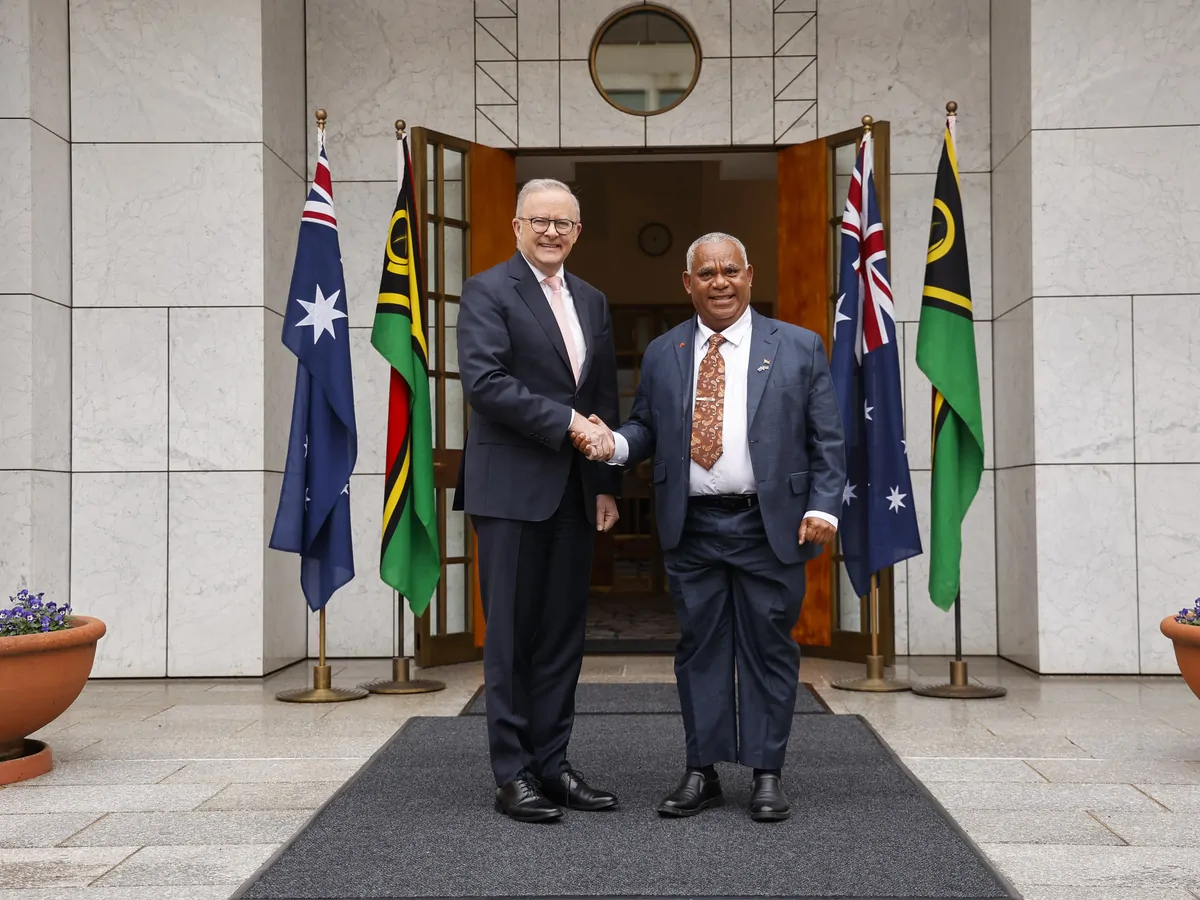
Australian Prime Minister Anthony Albanese and his Vanuatu counterpart Jotham Napat signed the Nakamal Agreement in the Australian capital Canberra on Monday, June 29, 2026. The ceremony marked the end of a drawn-out diplomatic process that had stumbled badly nine months earlier. In September 2025, Albanese had flown to Vanuatu expecting to sign the deal — only to be turned away hours before the ceremony after members of the Vanuatuan cabinet raised concerns that the original draft would limit their country's ability to attract outside investment.
The revised agreement addresses those concerns directly. Vanuatu retains the right to seek infrastructure funding from third parties, including China — but must now consult Australia whenever critical infrastructure is involved. Importantly, Australia no longer holds a veto, as had been proposed in the earlier version.
What the Agreement Actually Says
At its core, the Nakamal Agreement is a security guarantee with economic strings attached. Vanuatu formally commits to not allowing any foreign military base or military infrastructure on its territory. Critical infrastructure must be kept free from militarization and unauthorized foreign access. These provisions have been enshrined in Vanuatuan law: the government has already passed legislation prohibiting the militarization of critical infrastructure.
Australia, in turn, becomes Vanuatu's recognized primary partner for policing and security. The pact prioritizes cooperation with Pacific Islands Forum members — a grouping of 18 countries and territories that includes Australia — for both policing assistance and disaster response. In the event of a major natural disaster, Vanuatu has agreed to turn first to Australia, New Zealand, or France.
Napat also announced that the terms of the agreement would be shared with China. "There is nothing to hide," he told reporters. "Our government is transparent."
The Money — and What Remains Unclear
An earlier draft of the agreement had included a concrete figure: A$500 million (approximately US$345 million) in Australian support for Vanuatu over ten years. That number has not been officially confirmed in the signed version. Albanese said the financial details would be published in December, as part of Australia's Mid-Year Economic and Fiscal Outlook (MYEFO). Pacific security researcher Anna Naupa from the Australian National University called the signing a "significant milestone" following what she described as a prolonged period of uncertainty.
China's Shadow Over the Pacific
The Nakamal Agreement does not exist in a vacuum. It is one of several security arrangements Australia has signed or is currently negotiating with Pacific island states — all with one common thread: limiting Beijing's ability to establish a permanent military or security presence in the region.
China is Vanuatu's largest external creditor. Over the past decade, Beijing has financed the construction of major public buildings, roads, and port facilities across the island nation, using Chinese banks and Chinese contractors. This includes the presidential office complex, the parliament building, and Vanuatu's road network. More recently, China funded the expansion of a wharf in Luganville — a city that was once home to the largest American military base in the South Pacific during World War II. Canberra and Washington have watched that development closely.
China's navy has also made repeated port calls to Vanuatu. In 2023, Beijing deepened its security ties with Port Vila directly, donating drones, patrol boats, and vehicles to the island's police force.
Beijing Pushes Back — and Pursues Its Own Deal
China's foreign ministry reacted to the signing with measured skepticism. Spokesperson Guo Jiakun said Beijing hoped the cooperation between relevant countries and Pacific Island nations would serve regional development and stability — not target any third party or become a tool for geopolitical rivalry. China also said it would continue to expand cooperation with Vanuatu "in accordance with Vanuatu's wishes and needs."
Beijing is also actively pursuing its own bilateral agreement with Vanuatu. Known as the Namele Agreement, it is described by Napat as a "comprehensive development cooperation" deal. Napat confirmed on Monday that the agreement had not yet been signed and was still awaiting approval from Beijing. He rejected speculation that it contained security elements.
Former Australian diplomat James Batley was candid about what the Nakamal Agreement can and cannot achieve. "Vanuatu's long tradition of non-alignment means that it won't simply abandon its relationship with China," he told AFP. "Nor will China abandon its attempts to undermine Australia's interests in Vanuatu."
A Strategic Win — With Limits
For Australia, the signed agreement provides what Canberra has been seeking for years: a formal, legally grounded guarantee that no foreign military power will gain a foothold in Vanuatu. The 2022 security deal between the Solomon Islands and Beijing — which allowed Chinese troops, weapons, and naval ships access to the islands — sent shockwaves through Canberra and Washington. The Nakamal Agreement is, in part, a direct response to that moment.
For Vanuatu, the deal offers substantial economic support and development partnership while preserving its longstanding policy of non-alignment. The country of approximately 350,000 people has managed to balance competing interests from multiple powers for decades — and Monday's agreement suggests it intends to keep doing so.
.
Sources:
- Reuters – Australia and Vanuatu sign delayed security deal seen as curbing China (June 29, 2026): https://www.reuters.com/world/china/australia-vanuatu-sign-delayed-security-deal-that-is-seen-curbing-china-2026-06-29/
- Al Jazeera – Australia and Vanuatu sign deal to block foreign military bases (June 29, 2026): https://www.aljazeera.com/news/2026/6/29/australia-and-vanuatu-sign-deal-to-block-foreign-military-bases
- ABC News / Associated Press – A long-awaited Australia-Vanuatu pact blocks China from building a military base (June 29, 2026): https://abcnews.com/International/wireStory/long-awaited-australia-vanuatu-pact-blocks-china-building-134300351
- AFP / Cambodianess – Australia, Vanuatu Sign Deal Barring Foreign Military Base On Pacific Island (June 29, 2026): https://cambodianess.com/article/australia-vanuatu-sign-deal-barring-foreign-military-base-on-pacific-island
.
What's Your Reaction?
 Like
0
Like
0
 Dislike
0
Dislike
0
 Love
0
Love
0
 Funny
0
Funny
0
 Wow
0
Wow
0
 Sad
0
Sad
0
 Angry
0
Angry
0











Comments (0)