

Manila Looks to Taipei: Philippines Eyes Closer Ties to Guard Undersea Cables Against Chinese Pressure
A senior Philippine diplomat said in Washington on Wednesday that Manila is exploring deeper cooperation with Taiwan to protect undersea communication cables. He said this holds even though the Philippines officially recognizes Beijing, not Taipei. The move follows a series of tense encounters with Chinese-linked vessels near cable routes. Taiwan, meanwhile, is calling on the United Nations to address cable interference.

.
A Quiet Shift in Manila's Language
The Philippines is looking for closer practical cooperation with Taiwan to protect the cables that carry its internet traffic. That was the message from Felipe F. Carino III, deputy chief of mission at the Philippine Embassy in Washington, speaking at the Center for a New American Security on October 21.
Carino stressed that this cooperation is happening "notwithstanding" Manila's one-China policy. Under that policy, the Philippines formally recognizes the government in Beijing and not the one in Taipei. In other words, Manila is signaling that real-world security needs now outweigh diplomatic caution.
He described the approach as pragmatic. It would start with knowledge-sharing and capacity building, such as exchanging expertise and training. Carino did not name China directly. But he tied the effort to what he called "gray-zone" activity in the region.
What Is "Gray-Zone" Activity?
"Gray-zone" tactics are pressure measures that stay below the threshold of open military conflict. Examples include shadowing ships, harassing fishing boats, and sending "research" vessels into sensitive waters. The goal is to wear down a rival gradually, without firing a shot.
Both Manila and Taipei have repeatedly complained about such tactics. China claims Taiwan as its own territory. It also has overlapping claims with both Taiwan and the Philippines in the South China Sea.
Why Cables Matter So Much
Undersea cables are the hidden backbone of the modern world. Carino noted that they carry almost all intercontinental data traffic. He also said that 60 to 67 percent of cyber incidents occur in the Asia-Pacific region, a figure he presented in his remarks.
For an island such as Taiwan, a cut cable can mean slow connections, disrupted business and weaker links to the outside world. The Philippines is similarly exposed. Its main islands and the northern Luzon Strait region sit along key cable corridors.
Asked whether cooperation could eventually include joint patrols or holding ships accountable for damaging cables, Carino said he had no details. He added that the partnership is "constantly evolving" and that such steps may well come to pass.
The Bashi Channel: A Strategic Chokepoint
Carino singled out the Bashi Channel, the waterway between Taiwan and the northern Philippines. Cables run through this area, and it also lies close to a possible flashpoint in any future conflict over Taiwan.
Past incidents show why the concern is real. In 2023, the two cables linking Taiwan's Matsu islands to the main island were cut within days, first by a fishing vessel and then by a cargo ship. In June 2025, a Taiwanese court sentenced a Chinese captain to three years in prison over damage to a cable connecting Taiwan's main island and the Penghu islands. His ship, the Hong Tai 58, was registered in Togo.
A Confrontation Off Batanes
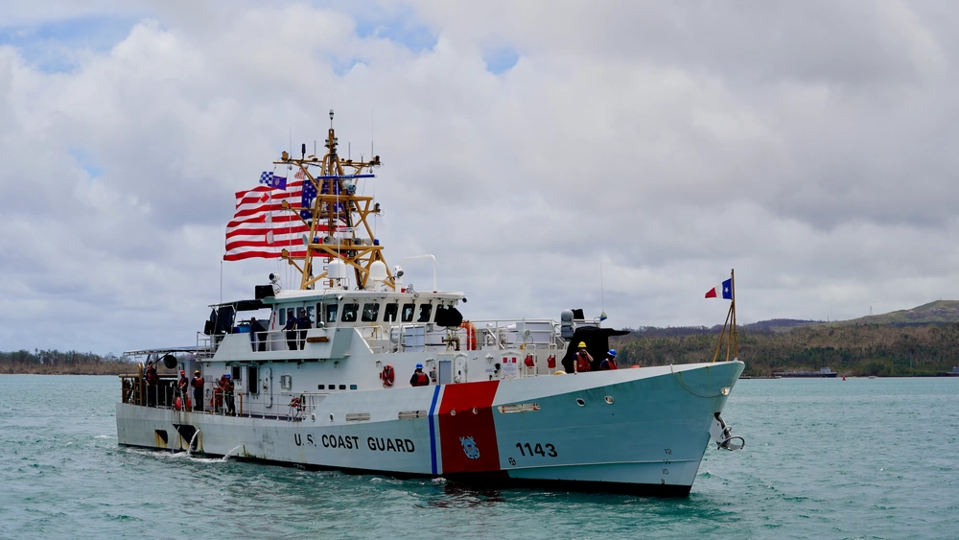
Earlier this month, tensions rose off the Philippines' northern Batanes province. On October 1, the Philippine Coast Guard said it had sent its largest vessel, the 97-metre BRP Teresa Magbanua, along with an aircraft. Their target was the Chinese research ship Jia Hai Ke 7, which had been loitering about 37 nautical miles from Itbayat Island since late September.
According to the coast guard, the survey ship had been falsifying its location signals. When Philippine boats approached, it repeatedly maneuvered to avoid them. A China Coast Guard vessel then arrived and tried to shield the research ship.
The Philippine side called that involvement "significant." The research ship is privately owned, which raises questions about its ties to the Chinese government and about what data it may have gathered near cable corridors off Batanes and the Luzon Strait.
China's embassy in Manila gave a different account. It said the vessel was carrying out "normal operations" in waters under Chinese jurisdiction and accused the Philippines of harassment. The Philippine coast guard, for its part, said the vessel was operating in the Philippines' exclusive economic zone without authorization.
Taiwan's Response: Drones and the United Nations
At the same Washington event, Andrea Yang, Taiwan's deputy representative to the United States, said Taipei is stepping up efforts to protect its undersea links. She pointed to the jailing of the Chinese ship captain as an example of Taiwan enforcing its rules. She also said Taiwan plans to invest more in unmanned systems to improve maritime surveillance.
Yang argued that cable interference should be taken up by the United Nations. She said the body should consider mechanisms to discourage "bad behavior" at sea. At present, international law on protecting undersea infrastructure is widely seen as hard to enforce, especially when the damage happens in contested waters.
Background: Cables Have Long Been a Geopolitical Issue
The Philippines has been reshaping its cable strategy for years. Philippine commentators have noted that, as U.S.-China relations soured, investment shifted toward cable networks with friendlier partners. One example is the Pacific Light Cable Network. It was originally designed with Chinese majority ownership to link Hong Kong, Taiwan, the Philippines and the United States. Washington's security reviewers recommended against its U.S. connection in 2020. The project was later restructured without Chinese ownership and control.
At home, Manila is also acting. In August, Philippine media reported that the country's three major telecom companies plan a roughly $500 million undersea cable project to connect all islands. Officials said the fiber could also carry sensors to help detect large-scale movement at sea. The most optimistic completion target is 2028.
Outlook
For now, Manila-Taipei cooperation appears to focus on practical steps rather than military alliance. Even so, the public shift is notable for a government that has kept formal distance from Taiwan for decades.
Key questions remain. Will "knowledge-sharing" grow into joint monitoring or patrols? Will the United States, which has close security ties to both partners, play a larger role? And will Beijing respond with more pressure, or with diplomatic protest?
One thing is clear: as the world's data flows through fragile lines on the seabed, the waters between Taiwan and the Philippines are becoming a test of how democracies protect shared infrastructure.
.
Sources
- Reuters, "Philippines exploring deeper cooperation with Taiwan to protect cables," October 21, 2026 – https://www.reuters.com/world/china/philippines-exploring-deeper-cooperation-with-taiwan-protect-cables-2026-10-21/
- Reuters, "Philippines sends largest ship, aircraft to drive away Chinese vessel in waters near Taiwan," October 1, 2026 – https://www.reuters.com/world/china/philippines-sends-largest-ship-aircraft-drive-away-chinese-vessel-waters-near-2026-10-01/
- Reuters, "Taiwan jails Chinese ship captain for damaging undersea cables," June 12, 2025 – https://www.reuters.com/business/media-telecom/taiwan-jails-chinese-ship-captain-damaging-undersea-cables-2025-06-12/
- Taipei Times, coverage of the Batanes incident, October 2, 2026 – https://www.taipeitimes.com/News/front/archives/2026/10/02/2003865248
- The Star (Malaysia), "Beijing slams 'harassment' after Manila challenges research ship near Batanes," October 2, 2026 – https://www.thestar.com.my/aseanplus/aseanplus-news/2026/10/02/beijing-slams-harassment-after-manila-challenges-research-ship-near-batanes
- Philippine Daily Inquirer (opinion), "Underwater cable contest" – https://opinion.inquirer.net/163033/underwater-cable-contest/amp
- The Philippine Star, "Telcos link up for $500 million national undersea cable project," August 3, 2026 – https://www.philstar.com/balita/2026/08/03/2546510/telcos-link-500-million-national-undersea-cable-project
.
What's Your Reaction?
 Like
0
 Dislike
0
 Love
0
 Funny
0
 Wow
0
 Sad
0
 Angry
0











Comments (0)