

Louis Vuitton's Court Win Over Chinese Tea Chain Ignites a Fight Over Who Owns a Flower
A Chinese court ordered bubble-tea chain Molly Tea to pay Louis Vuitton $1.5 million for copying its famous monogram. The ruling has triggered a heated online debate in China over whether the French brand's pattern actually borrows from ancient Chinese designs.

.
A Costly Cup of Tea
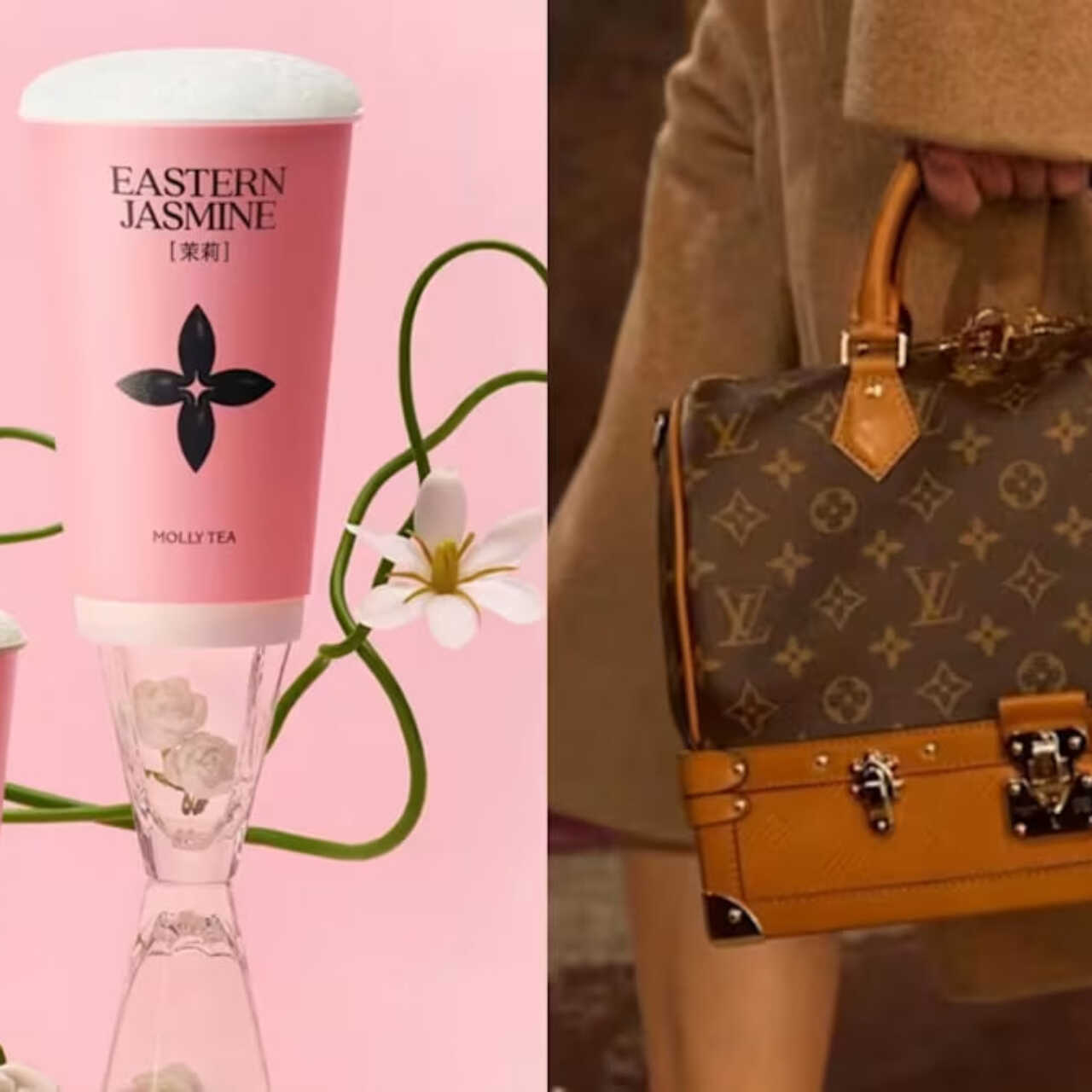
A court in Suzhou, in eastern China, has ruled against a homegrown tea brand in a trademark fight with French luxury house Louis Vuitton. The Suzhou Intermediate People's Court found that Molly Tea's four-petal flower logo infringed on seven of Louis Vuitton's registered trademarks.
Molly Tea must now pay 10.3 million yuan (about $1.5 million) in damages and legal costs within ten days. The court also ordered the company to publish a public apology on its website and on major Chinese social media platforms, including Weibo, WeChat, and Douyin.
.
Why the Two Logos Clashed
Louis Vuitton filed the lawsuit in May 2025, arguing that Molly Tea's black logo — four petals joined around a small diamond — was too close to its own 130-year-old monogram. Molly Tea, founded in Shenzhen in 2021, built its brand around jasmine and other floral teas and has grown to more than 2,000 stores worldwide, including outlets in the United States, Canada, Australia, and the United Kingdom.
Chinese trademark officials had already rejected Molly Tea's own attempts to register the logo in 2024. Louis Vuitton, by contrast, holds a registered trademark for its pattern in China. Under Chinese law, trademark rights generally go to whoever files first — a detail that weighed heavily in the court's decision.
Since the ruling, Molly Tea has quietly swapped the black-and-white version of its logo for a colored one on its social media accounts, a change some observers see as damage control.
.
A Nationalist Backlash Online
The verdict quickly became one of the most-discussed topics on Chinese social media. State-run outlets fanned the debate. The Beijing Daily asked on Weibo why a Chinese company had to pay millions to a French brand for a design that echoes patterns found in Chinese history. The Global Times ran a similar line, describing "widespread frustration" over what it framed as a foreign company laying claim to a piece of Chinese cultural heritage.
One widely shared comparison showed the floral pattern on a Tang Dynasty pipa — a traditional Chinese lute — placed next to the Louis Vuitton monogram. Some commentators went further, accusing the French house of trying to "monopolize" motifs that belong to everyone.
It's a notable pattern: state media in China has a track record of reframing commercial or legal setbacks for Chinese companies as questions of national pride, redirecting scrutiny away from domestic firms' own trademark practices and toward a foreign rival instead.
Not everyone online bought the framing, though. Some users pointed out that Louis Vuitton and Molly Tea operate in completely different industries — fashion versus beverages — and questioned whether the logos are really similar enough to cause confusion in the first place.
.
What Legal Experts Say
IP lawyers in Beijing offered a more measured take. Kang Lixia of Standzer IP Firm noted that Molly Tea still has the right to appeal and can present further evidence, but stressed that traditional cultural motifs are generally considered public domain — while specific commercial logos still need to avoid overlapping with brands that registered first. Liu Bin, another Beijing-based IP lawyer, made a similar point: heritage patterns should stay open for everyone to use, but that doesn't extend to copying another company's specific commercial branding.
.
Louis Vuitton's Side of the Story
Louis Vuitton is currently marking the 130th anniversary of its monogram, first created in 1896. According to parent company LVMH, the design was inspired by neo-Gothic ornamentation and Japanese artistic influences popular in Europe at the time — not by Chinese motifs. LVMH calls it a "universal symbol of creativity."
Neither LVMH nor Molly Tea has commented publicly beyond the tea chain's stated plan to appeal.
.
What Happens Next
Molly Tea has said it intends to challenge the ruling. Given the scale of the online reaction and the amount at stake, an appeal seems likely to keep the case — and the broader debate over who owns "traditional" patterns — in the headlines for a while yet.
.
Sources:
- South China Morning Post — https://www.scmp.com/business/companies/article/3359269/chinese-tea-chain-ordered-pay-louis-vuitton-us15-million-trademark-infringement
- WWD (Women's Wear Daily) — https://wwd.com/business-news/legal/chinese-beverage-maker-molly-tea-1239050519/
- China Daily — https://www.chinadaily.com.cn/a/202607/02/WS6a466e92a310986e2b4633a5.html
- Bangkok Post — https://www.bangkokpost.com/business/general/3281289/chinese-chain-molly-tea-ordered-to-pay-louis-vuitton-b50m-for-trademark-infringement
.
What's Your Reaction?
 Like
0
Like
0
 Dislike
0
Dislike
0
 Love
0
Love
0
 Funny
0
Funny
0
 Wow
0
Wow
0
 Sad
0
Sad
0
 Angry
0
Angry
0











Comments (0)