Canadian Canola Producers ‘Deeply Disappointed’ by China’s New Tariffs, Call for Ottawa’s Support

Aug 13, 2025 - 09:52
Updated: 9 months ago
0
Canadian Canola Producers ‘Deeply Disappointed’ by China’s New Tariffs, Call for Ottawa’s Support

.

Organizations representing Canadian canola producers are raising concerns about the impact of newly announced Chinese tariffs, saying that the latest duties, combined with earlier restrictions imposed this year, have effectively shut Canada out of its second largest canola export market.

China’s Ministry of Commerce announced on Aug. 12 it would impose 75.8 percent temporary tariffs on Canadian canola, starting on Aug. 14. The tariffs are part of a preliminary ruling from an anti-dumping investigation the regime launched last year, which the ministry says found “that canola imported from Canada is being dumped,” affecting China’s domestic industry. Dumping involves selling products to another country at a price below their normal value.
China’s announcement comes weeks after Ottawa said it will impose 25 percent tariffs on steel imports originating from China to protect Canada’s domestic industry.
In an Aug. 12 joint statement, the Canola Council of Canada (CCC) and Canadian Canola Growers Association (CCGA) said they are “deeply disappointed” with China’s decision, adding that since Beijing began its anti-dumping investigation last September, the Canadian canola industry had been consistent in its position that Canadian producers follow market-based rules.

“With this preliminary determination of dumping for canola seed together with the existing 100% anti-discrimination tariffs on canola meal and oil, the Chinese market is effectively closed to the Canadian canola industry,” said Chris Davison, president of the CCC.

China in March imposed 100 percent tariffs on Canadian canola oil, oil cakes, and pea imports, as well as 25 percent on aquatic and pork products. China declared that those levies stemmed from a domestic “anti-discrimination” investigation the regime said it initiated last year.
The anti-dumping investigation that led to the latest tariffs was launched by Beijing last September shortly after Canada imposed 100 percent tariffs on Chinese-made EVs and 25 percent tariffs on aluminum and steel products.
In announcing its tariffs on China last year, Ottawa said that Canadian industries were at risk due to “unfair” competition from Chinese producers who benefitted from China’s “intentional, state-directed policy of overcapacity and oversupply.”

The representatives of canola producers said in their Aug. 12 statement that Beijing’s decision “is timed for impact as farmers who planted canola in 2025 are preparing for harvest in a few weeks time.”

“This tariff will have an immediate and substantive impact on farmers’ marketing opportunities for the 2025 canola crop,” said Rick White, president of CCGA. “Canadian farmers are globally competitive and if a solution is not found swiftly, the impact will be quickly felt on our farms and in our rural communities.”

Both the CCGA and the CCC are calling on the federal government to provide “immediate support” as the industry navigates the effects of the trade dispute.

China is the second largest market for Canadian canola, after the United States. Total exports of canola products to China last year were valued at nearly $5 billion.

Tariffs

The Aug. 12 tariffs mark the latest escalation in growing trade tensions between Ottawa and Beijing. Canada last month announced increased tariffs on all steel imports—except those from the United States—containing steel melted and poured in China, with Prime Minister Mark Carney saying the measures were necessary to protect Canada’s steel industry from trade diversion. The move prompted Beijing to threaten countermeasures.

China has until September, when the anti-dumping investigation formally ends, to make a final decision on the duties, although it has the option of extending that deadline by six months. A final ruling could result in a different rate or overturn the Aug. 12 decision.

The Epoch Times reached out to the ministry of agriculture and agri-food and the ministry of international trade but did not hear back by publication time.

Conservative Leader Pierre Poilievre called the latest Beijing levies an “unjustified attack on our farmers,” noting they add pressure to an industry that has already been affected by tariffs.

“We stand ready to work with the government to fight and remove these tariffs and restore markets for our farmers and businesses,” Poilievre said in an Aug. 12 social media post.
Conservative Senate leader Leo Housakos described Beijing’s tariffs as evidence that China is not a reliable partner. 
“For anyone still under the illusion that China could be a reliable trading partner—this is what naivety and weakness earn you,” he said in an Aug. 12 social media post, commenting on the levies.
China’s Ministry of Commerce said in a separate Aug. 12 announcement it would launch an anti-dumping investigation into imports of Canadian pea starch.

Sask, Alberta React to Tariffs

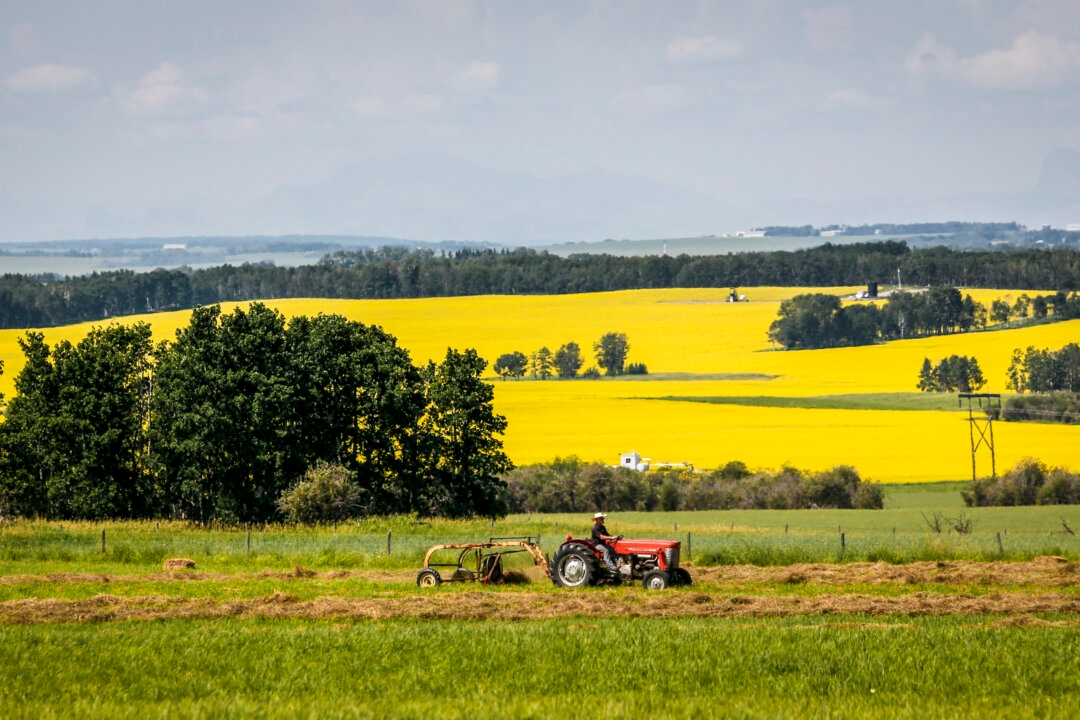
The governments of Alberta and Saskatchewan responded to the tariffs, urging Ottawa to take measures to protect the canola industry. Canadian canola is primarily grown in the Prairie provinces.
In an Aug. 12 press conference, Saskatchewan Premier Scott Moe said he was “extremely disappointed” with China’s decision and called on the federal government to support the canola industry, as it has done for other sectors like steel and lumber.

The latest tariffs “will have a devastating impact on the price points for Saskatchewan’s canola industry, and I would say ultimately Saskatchewans and producers,” Moe said.

He noted that Beijing’s measures were a response to Ottawa’s tariffs on Chinese electric vehicles, which were intended to protect a “fledging” Canadian industry largely concentrated in Eastern Canada.

“Our Canadian canola industry is every bit as important to our economy and jobs as Canadian steel, aluminum, auto manufacturing and forestry,” he said in an Aug. 12 statement. “And a lot more significant than the electric vehicle industry.”

Alberta Minister of Agriculture and Irrigation RJ Sigurdson called the latest tariffs “another devastating blow to Alberta’s agriculture industry,” echoing Moe’s concerns that the levies disproportionately affect a Western Canadian industry.

“Alberta’s farmers, ranchers and processors did not create this situation, yet they are paying the price,” Sigurdson said in an Aug. 12 statement.
Alberta Premier Danielle Smith has previously said that China’s targeted tariffs are part of a strategy meant to divide the country for the benefit of Beijing.
“This is how strategic China has been,” she said during a March fundraising event in Edmonton. “China is responding to the fact that we matched the tax on electric vehicles 100 percent by not taxing electric vehicles, but by taxing food.

“So they know that they’re pitting one region of our country against the other.”

Reuters contributed to this report.
.

What's Your Reaction?

Like Like 0
Dislike Dislike 0
Love Love 0
Funny Funny 0
Wow Wow 0
Sad Sad 0
Angry Angry 0

Comments (0)

User