

Beijing Vows to 'Safeguard Its Interests' as Washington Tightens Iran Sanctions Net
China's Foreign Ministry has pushed back after the Trump administration unveiled a sweeping new sanctions package targeting Iran's global trade network — one that, for the first time, directly hit Chinese and Hong Kong-based firms. The move is part of a broader US campaign to cut off Tehran's remaining financial lifelines nearly six months into the war between Washington and Iran.


.
A New Phase in the Pressure Campaign
US Treasury Secretary Scott Bessent unveiled the sanctions package on Monday, calling it "Operation Economic Outcast." He described the goal in blunt terms: to sever "every economic lifeline that sustains this tyrannical regime until Tehran stands alone."
The measures target dozens of individuals, companies and so-called shadow fleet vessels (ships that hide their origin to move sanctioned oil undetected) operating across Hong Kong, China, the United Arab Emirates, Singapore and Europe. Bessent expanded the sanctions categories to cover digital assets, technology, gold, aviation and shipping — areas Iran has used to work around existing restrictions.
"This is economic asphyxiation of this regime, and no one should test our resolve," Bessent said. Asked directly whether Chinese banks could be targeted, he did not rule it out: "No one is above this."
.
China Responds: 'We Will Safeguard Our Interests'
Beijing wasted no time answering. Foreign Ministry spokesman Lin Jian told reporters on Tuesday that cooperation between China and Iran "has always been conducted within the framework of international law" and "should not be interfered with or disrupted."
Lin repeated Beijing's long-standing position that it "firmly opposes illegal unilateral sanctions" and said China "will take all necessary measures to firmly safeguard its own rights and interests." He also called on all parties to "act rationally and with restraint," warning that sanctions and pressure tactics tend to escalate conflicts rather than resolve them.
The stakes for China are high. It remains by far Iran's largest oil customer, purchasing more than 90 percent of Iran's crude exports even after the war between the US and Iran began, according to Bessent. Independent tanker-tracking data cited by Reuters puts China's share of Iranian oil shipments last year above 80 percent. Any disruption to that trade — or to the Strait of Hormuz, the narrow waterway through which much of it passes — would hit Chinese refiners directly.
.
Behind the Standoff: A Fragile Truce
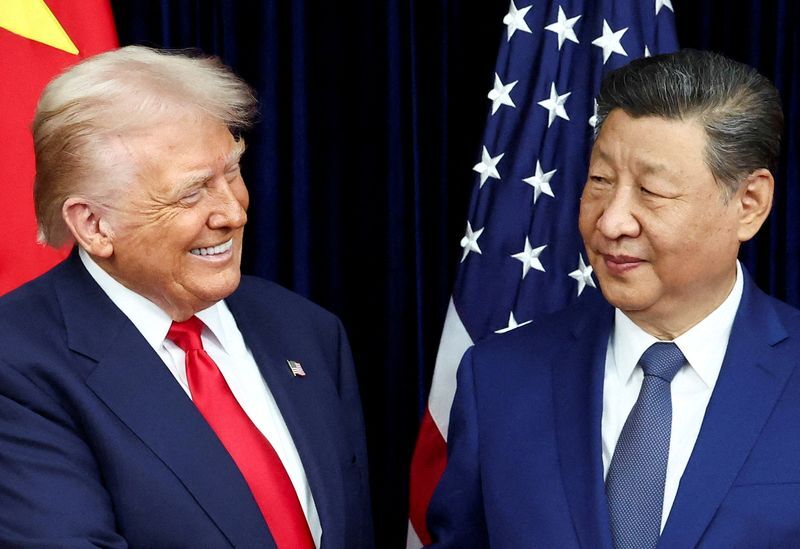
The timing matters. The US and China have maintained an uneasy trade truce since a damaging tariff war last year, and President Trump and Chinese leader Xi Jinping held a high-profile summit in Beijing in May. A follow-up meeting between the two leaders is planned in Washington for late September.
That diplomatic backdrop appears to be shaping Washington's approach for now. While the new sanctions hit smaller Chinese and Hong Kong firms — so-called "teapot" refineries and trading networks — the Trump administration has so far stopped short of sanctioning China's major state banks, the step that would cause the most economic pain in Beijing. Analysts note this restraint reflects a genuine dilemma for Washington: hitting China's financial system too hard could also strain the global economy and drive up oil prices worldwide.
Beijing, for its part, has shown before that it is willing to shield its companies from US pressure. In May, Chinese authorities ordered domestic firms not to comply with earlier US sanctions on five refiners linked to Iranian oil purchases — a signal that Beijing sees compliance with Washington's sanctions regime as optional, not obligatory.
.
Communist Beijing's Selective Diplomacy
China's foreign ministry frequently invokes "international law" when defending its trade with sanctioned regimes, yet Beijing has shown far less deference to international law and norms in disputes closer to home, from its territorial claims in the South China Sea to its treatment of religious and ethnic minorities. Critics argue that Beijing's partnership with Tehran — much like its close ties to Moscow — reflects a broader pattern under the Chinese Communist Party of propping up authoritarian regimes that share its opposition to a US-led international order, rather than a principled commitment to non-interference.
.
What Comes Next
The Trump administration has indicated this is only the opening move. Bessent said Washington would give countries time to "remedy bad behavior" before deciding on further steps, but added he has "no infinite patience." US officials have suggested that expanded secondary sanctions (penalties on foreign companies that do business with a sanctioned country) will remain the main tool of pressure at least until after the US midterm elections this fall, with a renewed military option reportedly still on the table if the economic campaign fails to change Tehran's calculus.
For Beijing, the coming weeks will test how far it is willing to go to protect its energy ties with Iran without jeopardizing the trade détente with Washington — and the Trump-Xi meeting planned for September.
.
Sources:
- Reuters (via KFGO): https://kfgo.com/2026/08/24/china-vows-to-protect-its-rights-as-us-readies-iran-sanction/
- Bloomberg: https://www.bloomberg.com/news/articles/2026-08-25/dozens-of-chinese-firms-hit-by-bessent-s-d-day-iran-sanctions
- NPR: https://www.npr.org/2026/08/24/g-s1-139743/treasury-secretary-scott-bessent-to-unveil-new-economic-sanctions-on-iran
- CNBC: https://www.cnbc.com/2026/08/24/trump-iran-economy-sanctions-china-bessent.html
.
What's Your Reaction?
 Like
0
Like
0
 Dislike
0
Dislike
0
 Love
0
Love
0
 Funny
0
Funny
0
 Wow
0
Wow
0
 Sad
0
Sad
0
 Angry
0
Angry
0











Comments (0)