

China Airs a Documentary on Myanmar's Scam Empires, but the Real Story Is Bigger Than Beijing's Version
China's state broadcaster CCTV has aired a three-part documentary on the crime families that ran huge online-fraud compounds in northern Myanmar. Several of their leaders were executed in early 2026. The film shows how brutal the scam industry was, with trafficked workers, beatings and extortion. But it is state-produced, and it leaves out how these networks grew for years right next to China's border. The same industry has also been hitting Americans, and Washington has now taken action.

.
A State Broadcaster Tells the Story
The series, titled The Demise of Telecom Fraud in Northern Myanmar, is airing on CCTV-1, China's main state television channel. It follows the Ministry of Public Security's campaign against criminal groups that ran "scam parks" (walled compounds where workers are forced to run online fraud) across the border.
According to The Standard, a Hong Kong outlet that reported on the film, it includes interviews with former gang members and survivors. Because CCTV is controlled by the Chinese Communist Party, the film should be read as the state's own account of events.
.
What Happened to the Crime Families
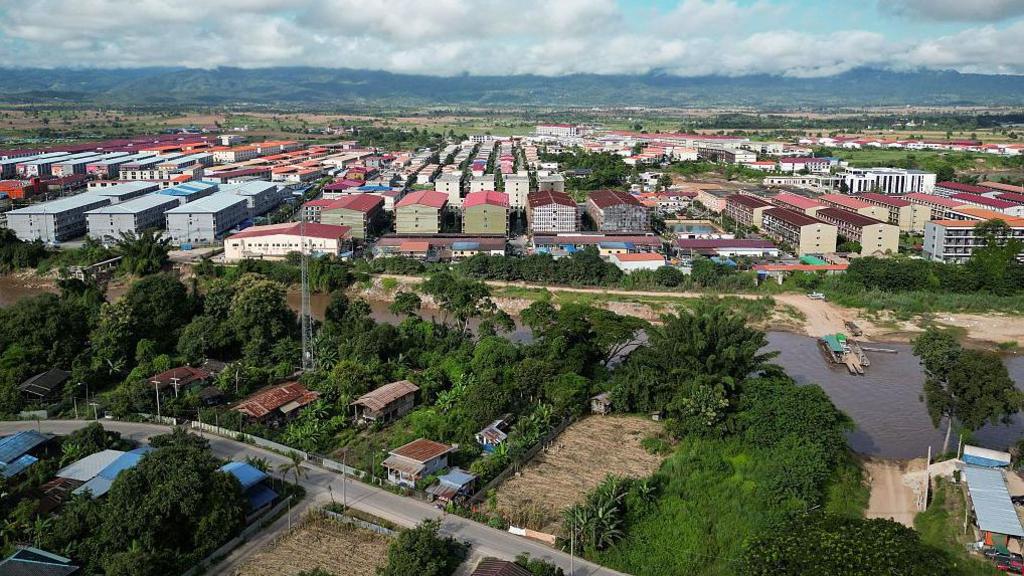
The documentary centers on the so-called "Four Families" of Myanmar's Kokang region, near the Chinese border. These clans ran casinos, scam compounds and private militias for years.
In late January 2026, China executed 11 members of the Ming family. They had been convicted of murder, illegal detention and large-scale fraud, according to Chinese state media cited by CNN. On February 2, a Shenzhen court announced the execution of four leaders of the Bai family, including Bai Yingcang. The court said the Bai group's fraud and gambling operations involved more than 29 billion yuan (about US$4.2 billion) and caused the deaths of six Chinese citizens, according to AP and RTHK.
The Bai family's patriarch, Bai Suocheng, was also sentenced to death. The court said he died of illness before the sentence could be carried out.
.
Inside the Compounds
The first episode focuses on the people trapped in the scam parks. A survivor identified only as Tang says he was forced to sign a debt contract and was sold between compounds. He says he was beaten until he could no longer walk, and that his captors finally forced the removal of his kidney to "clear" his debt. These claims come from the documentary and have not been independently verified.
Other reporting supports the general picture. Authorities said the Bai family built 41 compounds where beatings and torture were routine, according to the BBC. Investigators say the families also profited from drug production, prostitution and extortion.
The film also reportedly shows the wealth involved. A former associate of one boss says cash piled up so quickly that a guard could steal millions of yuan without being noticed. That is an anecdote from the film, not a verified fact.
.
The Hunt Across Borders
The later episodes cover how Chinese police chased suspects abroad. One example is She Zhijiang, the developer behind the Yatai New City project in Myanmar's Shwe Kokko area. Chinese authorities accused him of running more than 200 illegal online gambling operations. Thailand arrested him in 2022 and extradited him to China on November 12, 2025, according to AP. His company has said he acted only as a property developer under a legal license.
China's Ministry of Public Security says its campaign has led to more than 53,000 arrests of Chinese suspects since 2023, according to Chinese state media. Beijing also says telecom fraud cases fell for 11 straight months, and by 15.6 percent in the first half of 2026. These figures come from the Chinese government and could not be independently checked.
.
What the Documentary Leaves Out
A state-run film naturally tells only part of the story. Reporting by Chinese outlets such as The Paper shows that these networks expanded for years near the Chinese border, helped by corruption and armed groups. China's crackdown began in earnest only in 2023, after growing public anger over victims, according to reports cited by CNN and iGamingBusiness.
The industry has also proved hard to kill. Fortune reported in late 2025 that when one scam center is shut down, another often appears elsewhere. Earlier reporting found that gangs were already moving to Cambodia and targeting victims in Japan, South Korea, the United States and Europe.
There is also the question of the kidney claim itself. The idea of organs being taken by force is not new in China. In 2019, an independent panel in London, the China Tribunal, concluded that forced organ harvesting had taken place on a large scale and that Falun Gong practitioners were probably a main source. The tribunal was set up by a campaign group, and Beijing has repeatedly denied the allegations. The scam-park case is a different matter, but it is a reminder of why many observers remain cautious about claims coming from Chinese state media.
.
The American Angle
Scam centers in Southeast Asia are also a US problem. The US Treasury says Americans lost at least $10 billion to Southeast Asian scam operations in 2024, a 66 percent jump from the year before.
The Trump administration has responded with sanctions on the Cambodia-based Prince Group and on armed groups linked to compounds in Myanmar. It also created a Scam Center Strike Force with FBI, Secret Service and Treasury personnel, according to Treasury releases and Asia Financial. Beijing and Washington are now going after the same industry from different directions.
.
Outlook
The executions mark the end of the Ming and Bai families' reign in Kokang. But the industry that made them rich has not disappeared. It adapts, moves and finds new victims, while hundreds of thousands of people remain trapped in compounds across the region, according to the UN as cited by Fortune.
For readers, the film is worth watching with a critical eye. The crimes it describes are real and well documented. The full story of how these empires grew, and who allowed them to, is still not told.
.
Sources
- RTHK – "Four members of Myanmar-based fraud gang executed" (Feb 2, 2026): https://news.rthk.hk/rthk/en/component/k2/1842400-20260202.htm
- AP via WFTV – China executes four people over Myanmar scam and gambling operations (Feb 2, 2026): https://www.wftv.com/news/technology/china-executes-4/FDBGNRZUZA2ELFBL75POA4G3RA
- CNN via KTVZ – "China executes 11 members of gang who ran billion-dollar criminal empire in Myanmar" (Jan 2026): https://ktvz.com/news/national-world/cnn-world/2026/01/28/china-executes-11-members-of-gang-who-ran-billion-dollar-criminal-empire-in-myanmar/
- BBC via The Star – "China executes four more Myanmar mafia members" (Feb 2, 2026): https://www.the-star.co.ke/news/world/2026-02-02-china-executes-four-more-myanmar-mafia-members
- Caixin Global – "China Executes Four More Chiefs in Myanmar Cyberfraud Crackdown" (Feb 2, 2026): https://www.caixinglobal.com/2026-02-02/china-executes-four-more-chiefs-in-myanmar-cyberfraud-crackdown-102410491.html
- AP via Khaosod English – "Thailand Extradites a Suspect in Illegal Gambling Operations to China" (Nov 12, 2025): https://www.khaosodenglish.com/news/2025/11/12/thailand-extradites-a-suspect-in-illegal-gambling-operations-to-china/
- Sixth Tone – "The Dark Reality of Telecom Fraud in Northern Myanmar": https://www.sixthtone.com/news/1013619/the-dark-reality-of-telecom-fraud-in-northern-myanmar
- Fortune – "The world targets Southeast Asia's notorious scam centers" (Nov 15, 2025): https://fortune.com/2025/11/15/southeast-asia-scam-centers-cambodia-myanmar-human-trafficking-cybercrime
- US Department of the Treasury – Press release on Prince Group TCO sanctions: https://home.treasury.gov/news/press-releases/sb0538
- Asia Financial – "US Offering Big Money to Nab Southeast Asian Scam Bosses": https://www.asiafinancial.com/?p=109025
- Law Society Gazette (Ireland) – "China continues to kill prisoners for organ transplants, tribunal concludes" (2019): https://www.lawsociety.ie/gazette/top-stories/2019/06-june/china-continues-to-kill-prisoners-for-organ-transplants-tribunal-concludes/
- The Standard (HK), on the documentary itself: https://www.thestandard.com.hk/china/article/344644/
.
What's Your Reaction?
 Like
0
Like
0
 Dislike
0
Dislike
0
 Love
0
Love
0
 Funny
0
Funny
0
 Wow
0
Wow
0
 Sad
0
Sad
0
 Angry
0
Angry
0













Comments (0)