

$327 Million Australia-Vanuatu Agreement Strengthens Security and Economic Cooperation Amid China Concerns

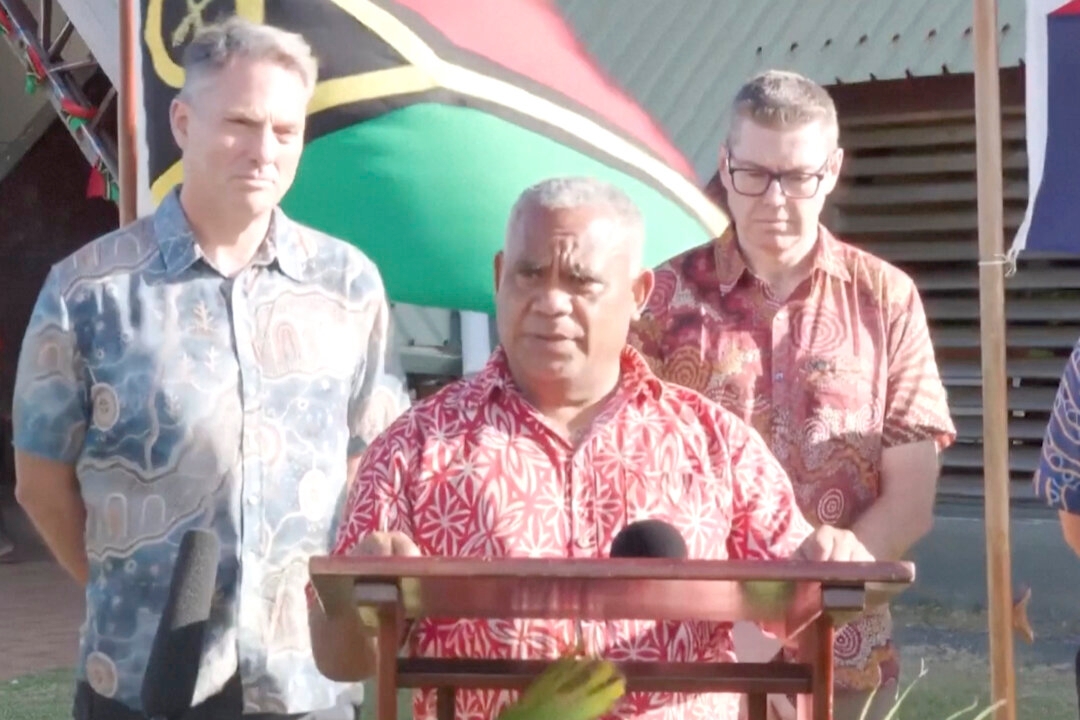
Australia and Vanuatu announced on Wednesday a $327 million security and economic pact, a move that could affect China’s role as the island’s biggest external creditor.
Prime Minister of Vanuatu Jotham Napat applauded the deal, formally called the Nakamal Agreement, as a “win-win situation.”
Deputy Prime Minister of Australia Richard Marles echoed the sentiment of establishing closer ties between the two nations.
“[This agreement] acknowledges our shared economic connection,” said Marles. “It acknowledges that as neighbours, we have a shared security environment and a commitment to each other.”
The Nakamal Agreement is set to be finalised in the coming weeks in September, which requires signatures from both leaders—Napat and Australian Prime Minister Anthony Albanese, announced Napat.
Minister of Foreign Affairs Penny Wong stressed Australia’s commitment to developing a long-term relationship. The most important thing is “where we will be [in] three and five and ten years,” she said.
China has emerged as a major infrastructure partner for Vanuatu over the past decade, funding projects including roads on Tanna and Malekula Islands, an airport runway upgrade in Port Vila, and a presidential palace—all either fully or partially financed by Chinese concessional loans or grants.
Amid these financial ties, reports of a prospective Chinese military base on the island—particularly related to the Luganville wharf—have surfaced. Both the Chinese Ministry of Foreign Affairs and Vanuatu’s Foreign Minister have officially refuted the claims, with Chinese authorities labeling them as “fake news.”
Vanuatu has consistently maintained that it is neither aligned with the West nor with China, upholding a non-aligned policy aimed at preserving sovereignty and strategic flexibility.
Australia, meanwhile, has voiced heightened concern over China’s expanding military posture and influence across the Pacific—especially after live-fire naval drills that allegedly disrupted commercial air traffic in the Tasman Sea in February.
At the Shangri-La Dialogue in Singapore in May, Marles pressed Beijing for more transparency regarding military drills.
“When you look at the growth in the Chinese military that has happened without a strategic reassurance, or a strategic transparency ... we would like to have a greater transparency in what China is seeking to do in not only its build up, but in the exercises that it undertakes,” the deputy prime minister of Australia said.
What's Your Reaction?
 Like
0
Like
0
 Dislike
0
Dislike
0
 Love
0
Love
0
 Funny
0
Funny
0
 Wow
0
Wow
0
 Sad
0
Sad
0
 Angry
0
Angry
0












Comments (0)