

China's Gig Economy Is Booming — But It's Quietly Swallowing the Middle Class
China's gig economy has ballooned to roughly 320 million workers this year, absorbing everyone from laid-off factory hands to former software engineers. Behind the growth numbers lies a quieter story: a generation trading job security for survival, and a welfare system that isn't ready to catch them if they fall.

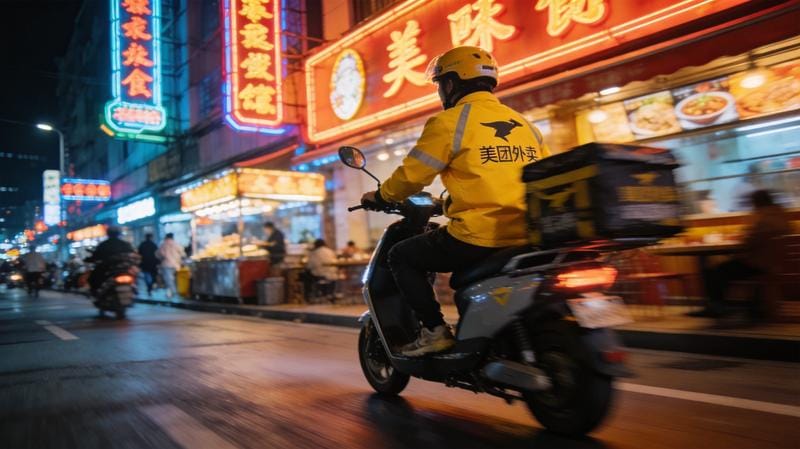
.
A Software Tester Behind the Wheel
Bao Zhang used to write code. Now he drives.
After losing his job as a software tester earlier this year, the 30-year-old Beijing resident turned to ride-hailing to pay the bills. He's behind the wheel from 7 a.m. until nearly midnight, six days a week, earning about 6,000 yuan ($885) a month after covering his rental car and charging costs.
"Those who used to take taxis now have to drive them themselves," he said.
It's a line that sums up a much bigger shift happening across China. Millions of white-collar workers — engineers, marketers, mid-level managers — are sliding into the same informal economy long associated with rural migrants and delivery riders. What used to be a fallback for the least-skilled is becoming a landing pad for the overqualified.
From Safety Net to Default Setting
According to the China New Employment Forms Research Center, a Beijing-based think tank, the number of people working without a permanent, full-time contract is set to hit 320 million this year, up from 280 million in 2025. That's nearly as many people as live in the entire United States — and it now makes up about 44 percent of China's entire workforce.
The trend didn't start this year. Flexible employment has grown steadily from roughly 200 million workers in 2021, but the pace has picked up sharply as China's property crisis, factory automation and an unprecedented wave of university graduates collide with a shrinking pool of formal jobs.
"It's no longer limited to rural migrants and has spread to the middle class and university graduates," said Yang Zhan, a cultural anthropology researcher at Hong Kong Polytechnic University. She points to a double squeeze: entire manufacturing sectors are being phased out as China upgrades its industrial base, while artificial intelligence is quietly eating into white-collar jobs on the other end.
For now, the gig economy is absorbing the shock. Whether that's a sign of resilience or a symptom of deeper trouble depends on who you ask.
The Insurance Nobody's Buying
Here's the catch: none of this work comes with the safety net that a formal job would.
Social insurance contributions — pension, medical coverage, work injury protection — aren't mandatory for gig workers in China. Most simply go without. A government report released in December 2025 found that by the end of 2024, only 70.6 million flexible workers were enrolled in the urban employee pension scheme, a small fraction of the total.
Bao Zhang is one of them. He's skipped medical insurance entirely, and says a pension feels "too far away" to bother with — and too small to matter anyway. His body may disagree eventually: he already suffers recurring ankle and knee pain from the long hours spent behind the wheel.
He's not alone in that calculation. A Peking University survey of 30,000 delivery workers found fewer than 10 percent would even support mandatory social security contributions — unsurprising, given that such a scheme would cost workers around 10 percent of their income and employers roughly a quarter of theirs.
Some workers see it differently. Angel An, a 24-year-old who promotes her ride-hailing services to tourists in Shanghai and Suzhou via social media, prefers handling her own finances rather than paying into a system she may never fully benefit from.
"I can take control, rather than wait for decades for others to pay me," she said.
A Pension System Already Under Strain
The bigger worry isn't any single driver or delivery rider — it's what happens when tens of millions of them reach retirement age with little or nothing saved.
China's national pension fund was already flagged as a long-term risk before the gig economy exploded. A 2019 study by the Chinese Academy of Social Sciences warned the fund could run dry by 2035 as the population ages; a 2024 update suggested raising the retirement age could buy another eight or nine years. Government transfers plugging holes in the social insurance budget have roughly tripled over the past decade, according to research firm Gavekal Dragonomics, now accounting for one in every ten yuan of state spending.
Nomura's chief China economist, Ting Lu, argues the priority should be making it easier — not more expensive — for flexible workers to opt into the formal system. "We need to reduce anxiety," he said, "so that they save less and consume more."
HSBC economist Frederic Neumann sees a generational shift taking shape. "A whole new generation is growing up unaccustomed to the security and confidence that their parents for a long time enjoyed," he said — a shift that, in his view, risks weighing on consumer spending for years to come.
Beijing's Balancing Act
The government finds itself boxed in. Push platform companies to shoulder more welfare costs, and the industry's ability to keep absorbing surplus labor could take a hit. Do nothing, and the pension math only gets worse.
There's also a political dimension analysts are watching closely. In June 2026, China backed a new International Labour Organization convention on decent work in the platform economy — a gesture toward reform. But according to Human Rights Watch, the government's own domestic policy pledge issued the same year paired promises of better pay and social security with language calling on gig workers to "follow the Party," with Party organizations expected to maintain what the pledge called "comprehensive coverage" over the sector. Whether Beijing's commitment to gig workers is really about their welfare — or about keeping a increasingly large and mobile workforce under closer watch — remains an open question.
Meanwhile, the ride-hailing sector is already showing signs of strain from its own success. At least four Chinese cities, including the tech hub Shenzhen, have issued warnings since April about market "saturation" — too many drivers chasing too few rides.
Not Much Choice Left
For many gig workers, the debate over pensions and platform regulation feels distant. What matters is getting through the week.
Li, a cleaner in his early 50s, spends his evenings delivering food until 10 p.m., picking up an extra 40 to 100 yuan a day. He suspects the growing crowd of riders is squeezing what he earns per delivery, but doesn't see another option.
"At my age, without education, what could I possibly do?" he said. "In Beijing, most college students also have to deliver food."
That last detail — university graduates and unskilled laborers competing for the same delivery routes — captures where China's gig economy has ended up: not a stepping stone to something better, but increasingly the only stone left to stand on.
.
Sources
- Reuters – "China's booming gig economy masks job market pain, strains welfare system" – https://www.reuters.com/business/world-at-work/chinas-booming-gig-economy-masks-job-market-pain-strains-welfare-system-2026-07-06/
- Human Rights Watch – "Gig Workers in China Need More Than Promises" – https://www.hrw.org/news/2026/06/17/gig-workers-in-china-need-more-than-promises
- NTU Singapore, School of Social Sciences – "Number of people in China engaged in flexible employment is expected to reach 320 million this year" – https://www.ntu.edu.sg/sss/news-events/news/detail/china-engaged-in-flexible-employment
.
What's Your Reaction?
 Like
0
Like
0
 Dislike
0
Dislike
0
 Love
0
Love
0
 Funny
0
Funny
0
 Wow
0
Wow
0
 Sad
0
Sad
0
 Angry
0
Angry
0














Comments (0)