

CCP Unlikely to Annex Taiwan by Military Force in Near Future After Top Political Meeting, Analysts Say


.
China’s ruling Chinese Communist Party (CCP) has adopted softer rhetoric about annexing Taiwan after officially taking down several generals who were key figures in the Taiwan Strait theater at its recent top political meeting, the Fourth Plenum.
Analysts said the CCP is unlikely to invade Taiwan in the near future, given internal chaos caused by the heated infighting, but the long-term goal to annex the self-ruled island remains.
The official communiqué of the CCP’s Fourth Plenum, released by the Chinese state media outlets on Oct. 24, said in the regime’s 15th Five-Year Plan (2026-2030), its goal regarding Taiwan is to “promote the peaceful development of relations across the Taiwan Strait and advance the cause of national reunification.”
Unlike previous official speeches and statements about Taiwan, the plan didn’t show urgency or a timeline for the “reunification,” nor did it say or hint that the CCP has not ruled out the use of force.
At the Fourth Plenum, which took place from Oct. 20 to Oct. 23, the CCP announced the expulsion of nine top generals from the Party and the military following the Ministry of Defense’s announcement of an investigation into the generals on Oct. 17.
These generals were key figures in leading a possible invasion of Taiwan. Among them, He Weidong, Miao Hua, Lin Xiangyang, Qin Shutong, and Wang Xiubin all served in the 31st Group Army, headquartered in Xiamen, Fujian Province, across the strait from Taiwan.
The 31st Group Army was reorganized in 2017 as the 73rd Group Army under the People’s Liberation Army’s (PLA) Eastern Theater Command that oversees operations in the Taiwan Strait. He Hongjun, Yuan Huazhi, and Wang Houbin were all former subordinates of Miao Hua, and Wang Chunning also served in the Eastern Theater Command. CCP leader Xi Jinping’s base was in Fujian, and the 31st Group Army was considered “Xi’s family army.”
Xi said “reunification” with Taiwan is “inevitable,” and the CCP has never ruled out the possibility of a military invasion. Taking Taiwan is Xi’s major ambition, as it would solidify his legacy and power within the party.
Yeh Yao-Yuan, professor of Political Science and International Studies at the University of St. Thomas, said that the softened tone about “reunification” with Taiwan in the Fourth Plenum “may be related to Xi Jinping’s upcoming meeting with U.S. President [Donald] Trump.”
The White House has confirmed that Trump will meet with Xi on Oct. 30 during the Asia-Pacific Economic Cooperation summit in South Korea.
The CCP does not want to say anything to irritate the United States over the security of the Taiwan Strait before meeting with Trump, Yeh told The Epoch Times.
The rhetoric in the communiqué “is just the CCP choosing what to say at what time,” he said. “The CCP will not give up the idea of annexing Taiwan by military force.”
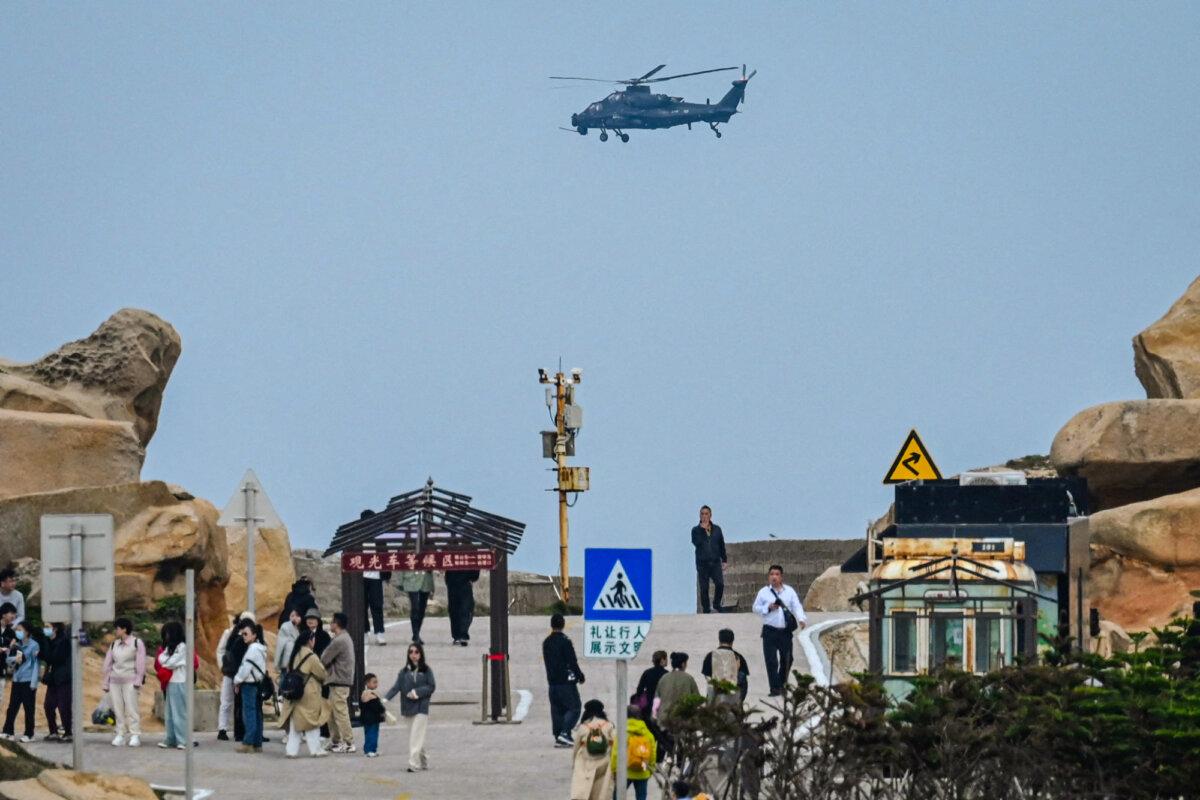
The Chinese regime has intensified its military exercises around Taiwan and incursions into Taiwan’s airspace in recent years.
From 2022 to 2025, the scale of the CCP’s exercises against Taiwan has decreased, and “they seemed to avoid using live ammunition,” said Shen Ming-shih, research fellow at the Division of National Security Research at Taiwan’s Institute for National Defense and Security Research.
“In particular, the exercises in April focused heavily on propaganda and lacked real combat effectiveness. It has now been proven that neither He Weidong nor Lin Xiangyang was in command,” Shen told The Epoch Times.
Lai Rongwei, Taiwanese researcher on international relations and CEO of the pro-democracy nonprofit Taiwan Inspirational Association, told The Epoch Times that whether Xi has full control of the CCP’s military after the Fourth Plenum remains to be seen, which is “a big variable.”
.
Taiwan Retrocession Day
The Chinese communist regime’s National People’s Congress designated Oct. 25 as “Commemoration Day of Taiwan’s Restoration” on Oct. 24, and the CCP held a high-profile event to celebrate the day, which it had never done before. The day is known as “Taiwan Retrocession Day” in Taiwan.The Republic of China (ROC) ruled mainland China from 1911 to 1949. After World War II, Taiwan, which was occupied by Japan from 1895 to 1945, was returned to the ROC; the formal handover was completed on Oct. 25, 1945. After being defeated by the communists on the mainland in 1949, the ROC government retreated to Taiwan. The CCP then established the communist regime—the People’s Republic of China (PRC)—on the mainland. PRC has never ruled Taiwan, and Taiwan’s official name is the Republic of China, as shown on its citizens’ passports.

Taiwan’s Mainland Affairs Council of the Republic of China immediately criticized the CCP’s designation of the “Commemoration Day of Taiwan’s Restoration” as an attempt to “belittle our country and fabricate the claim that Taiwan belongs to the PRC.”
“Taiwan Retrocession Day has nothing to do with the PRC, nor with the CCP, which made no positive contribution to the war against Japan,” the council said on Oct. 24.
The council said the Taiwanese people “will never accept” such a move, nor the CCP’s false historical narrative and one-sided political framework of “one China across the Taiwan Strait” and “one China internationally.”
The CCP also uses the ambiguous phrase “Taiwan was liberated by China [from Japan’s occupation]” to deliberately mislead others to believe that the PRC liberated Taiwan, Yeh said.
“This is a form of cognitive warfare,” he said. “The CCP continues to promote its narrative of the Taiwan Strait becoming a Chinese inner sea in mainland China.”
Such false narratives “could deceive mainland Chinese people who are unfamiliar with history [due to the CCP’s textbooks that distort history], as well as other foreigners, but are ineffective against Taiwanese people,” Yeh said.
What's Your Reaction?
 Like
0
Like
0
 Dislike
0
Dislike
0
 Love
0
Love
0
 Funny
0
Funny
0
 Wow
0
Wow
0
 Sad
0
Sad
0
 Angry
0
Angry
0














Comments (0)