

China's CEO Delegation for Xi's Washington Visit Meets US Industry Pushback
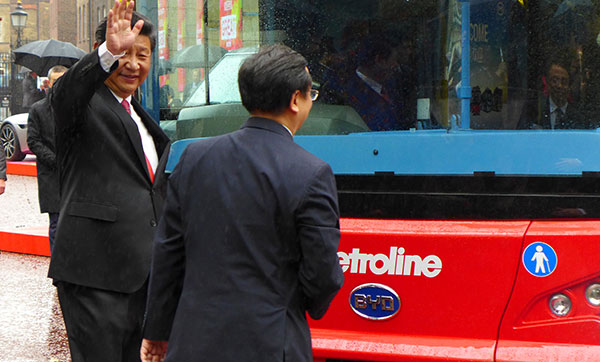
Washington and Beijing are finalising a group of Chinese business leaders to join President Xi Jinping's visit to the United States next week, with some of the invited companies already facing US regulatory scrutiny. Just days before the summit, major American, Japanese, German and Korean automakers have urged President Trump to keep Chinese carmakers out of the US market entirely. The clash highlights how sensitive the visit has become, even as both governments try to project a friendly tone ahead of high-level talks.

.
A Rare Move by Beijing
China and the United States are putting together a list of Chinese business leaders to accompany Xi Jinping when he travels to Washington, according to people familiar with the plans. Formal invitations are expected within days, and the US State Department is likely to approve visas for the group.
Bringing a large business delegation abroad is unusual for Xi. Many Chinese executives fell out of favour after Beijing's regulatory crackdowns on the technology, education and property sectors that began in 2020, and the Chinese Communist Party (CCP) has since kept a much tighter grip on private enterprise.
.
Which Companies Could Join
Executives under consideration reportedly include leaders from electric-vehicle maker BYD, smartphone and EV producer Xiaomi, battery manufacturers CATL and Gotion, electronics maker Hisense, auto-parts supplier Wanxiang Group, state-owned Bank of China, and agricultural conglomerate COFCO. The final list has not yet been confirmed.
BYD declined to comment when approached. CATL, Xiaomi, Wanxiang, Hisense, Gotion and Bank of China did not respond to requests for comment. China's foreign ministry said it had no information to share, and the commerce ministry did not respond either.
.
Companies Already Under US Scrutiny
Several of the firms being considered are already dealing with American regulatory pressure. CATL and BYD were both added to a Pentagon list flagging alleged ties to China's military — BYD in June 2026 and CATL in January 2025.
Ford's use of licensed CATL battery technology at its Michigan plant has drawn criticism from US lawmakers concerned about Chinese influence in the American EV supply chain. Separately, Gotion is suing a Michigan township over a blocked $2.36 billion EV-components plant, while Wanxiang agreed in December to pay more than $53 million to settle a Justice Department case involving customs and anti-dumping duties on Chinese auto parts.
.
US Auto Industry Pushes Back Ahead of the Summit
Just days before the summit, six major US industry groups sent a letter to President Trump urging him to keep the American market closed to Chinese automakers. The groups represent General Motors, Toyota, Volkswagen, Ford, Hyundai, Stellantis, Tesla and other manufacturers, suppliers and dealers operating in the United States.
"We urge your administration to maintain policies that keep the door firmly shut to Chinese automakers seeking to sell, import or manufacture vehicles inside the U.S.," the letter states. The signatories argue that Chinese automakers currently have no market share in the US, and that allowing a domestic footprint would come "at the expense of manufacturers operating here" rather than create new American jobs.
The letter follows comments Trump made to Fox News last week, in which he said he would be open to Chinese car companies building vehicles inside the United States. Michigan Democratic Senator Elissa Slotkin went further, pointing to reports that Xi may bring BYD executives to Washington and suggesting this could signal talks about allowing Chinese-made cars into the US market or letting Chinese firms set up manufacturing on American soil.
.
The Existing Rules Chinese Automakers Face
A regulation introduced by the Biden administration in early 2025 effectively bars Chinese automakers from selling or building passenger vehicles in the US, citing national-security concerns that connected-car technology could send sensitive driver data back to China. The rule covers Bluetooth, Wi-Fi, cellular and some satellite communication systems built into vehicles.
Washington also maintains tariffs of more than 100 percent on Chinese electric vehicles, and Congress is currently weighing legislation that would tighten the existing restrictions even further rather than loosen them.
.
Beijing Seeks a Reciprocal Gesture
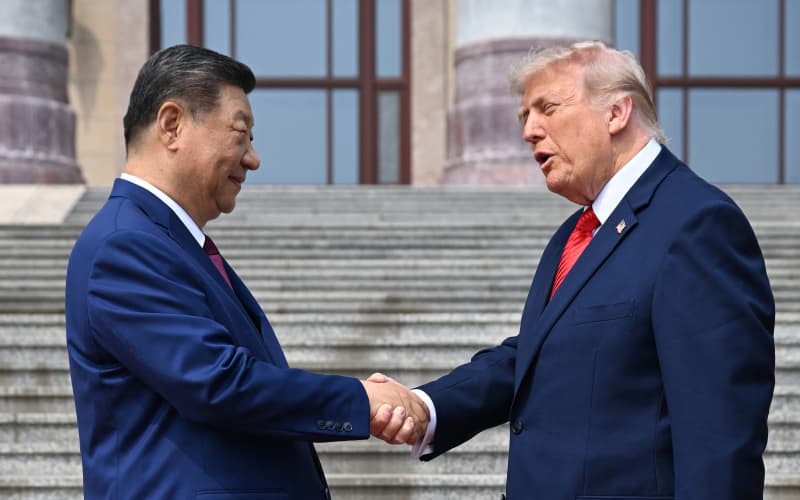
China's plan for a large delegation appears designed to mirror Trump's own trip to Beijing in May, when he brought executives from companies such as chipmakers Micron and Qualcomm and gene-sequencing firm Illumina — all of which have faced friction with Chinese regulators. Beijing's delegation is expected to be similar in size, matching the format of that earlier visit.
Chinese executives are reportedly not expected to meet separately with American think tanks or business groups during the trip. Beijing had proposed a joint US-China CEO roundtable, but the White House turned the idea down. The visiting executives are still expected to attend a White House state dinner alongside guests such as Nvidia CEO Jensen Huang and OpenAI's Sam Altman.
.
What's at Stake for the Summit
Trump is expected to host Xi Jinping in Washington on September 24, with the Chinese leader reportedly arriving on September 23 and departing on September 25. The visit follows Trump's own trip to Beijing in May and comes as both governments try to preserve a fragile trade truce first reached last October in South Korea.
For the Trump administration, priorities for the summit reportedly include a possible agreement on a bilateral Board of Trade, more export licences for US firms seeking Chinese rare earths, and an extension of the trade truce. The fresh pushback from the US auto industry shows that any opening toward Chinese carmakers would face fierce domestic resistance, giving Trump's team a strong hand to negotiate from without having to offer concessions on this front.
For Beijing, the choreography of the trip — a large CEO delegation, a state dinner, careful avoidance of independent business forums — reflects a Communist Party that keeps firm control over how, when and through whom its companies engage with the outside world. Even China's most prominent private firms move only with the Party's clearance.
.
Sources
- Reuters — "Auto industry urges Trump to keep Chinese automakers out ahead of Xi meeting," September 18, 2026: https://www.reuters.com/business/autos-transportation/auto-industry-urges-trump-keep-chinese-automakers-out-ahead-xi-meeting-2026-09-18/
- Reuters (via Internazionale) — "Exclusive: China's Xi to bring large CEO delegation on US visit, sources say," September 4, 2026: https://www.internazionale.it/ultime-notizie-reuters/2026/09/04/exclusive-china-s-xi-to-bring-large-ceo-delegation-on-us-visit-sources-say
- South China Morning Post — "Prediction markets have priced the Trump-Xi summit. Do the bets have any value?": https://www.scmp.com/news/china/diplomacy/article/3365846/prediction-markets-have-priced-trump-xi-summit-do-bets-have-any-value
- The Standard (Hong Kong) — "BYD, CATL, Xiaomi executives may join Xi's US visit, sources say": https://www.thestandard.com.hk/finance/article/343216/
.
What's Your Reaction?
 Like
0
Like
0
 Dislike
0
Dislike
0
 Love
0
Love
0
 Funny
0
Funny
0
 Wow
0
Wow
0
 Sad
0
Sad
0
 Angry
0
Angry
0









Comments (0)